

Environmental Health Starts in the Restroom: What India’s Commercial Buildings Are Getting Wrong
A Restroom can look clean, smell fresh and still have an environmental health problem.
That is what makes washrooms so easy to overlook. They sit quietly inside offices, hospitals, malls, factories, hotels and campuses. Thousands of people may use them every day, yet restroom management is often reduced to three questions. Does it look clean?Does it smell okay?Was it cleaned on schedule? Environmental health asks for a wider view. What are people breathing? What are they touching? What is being put into the environment? And what happens when water, chemicals and microorganisms meet in the same small space? On World Environmental Health Day, September 26, the International Federation of Environmental Health is focusing on the theme “Environmental Health: Standing with Science to Protect Communities.” The day highlights the connection between the environment around us and human health. The commercial restroom is a surprisingly good place to see that connection in action.
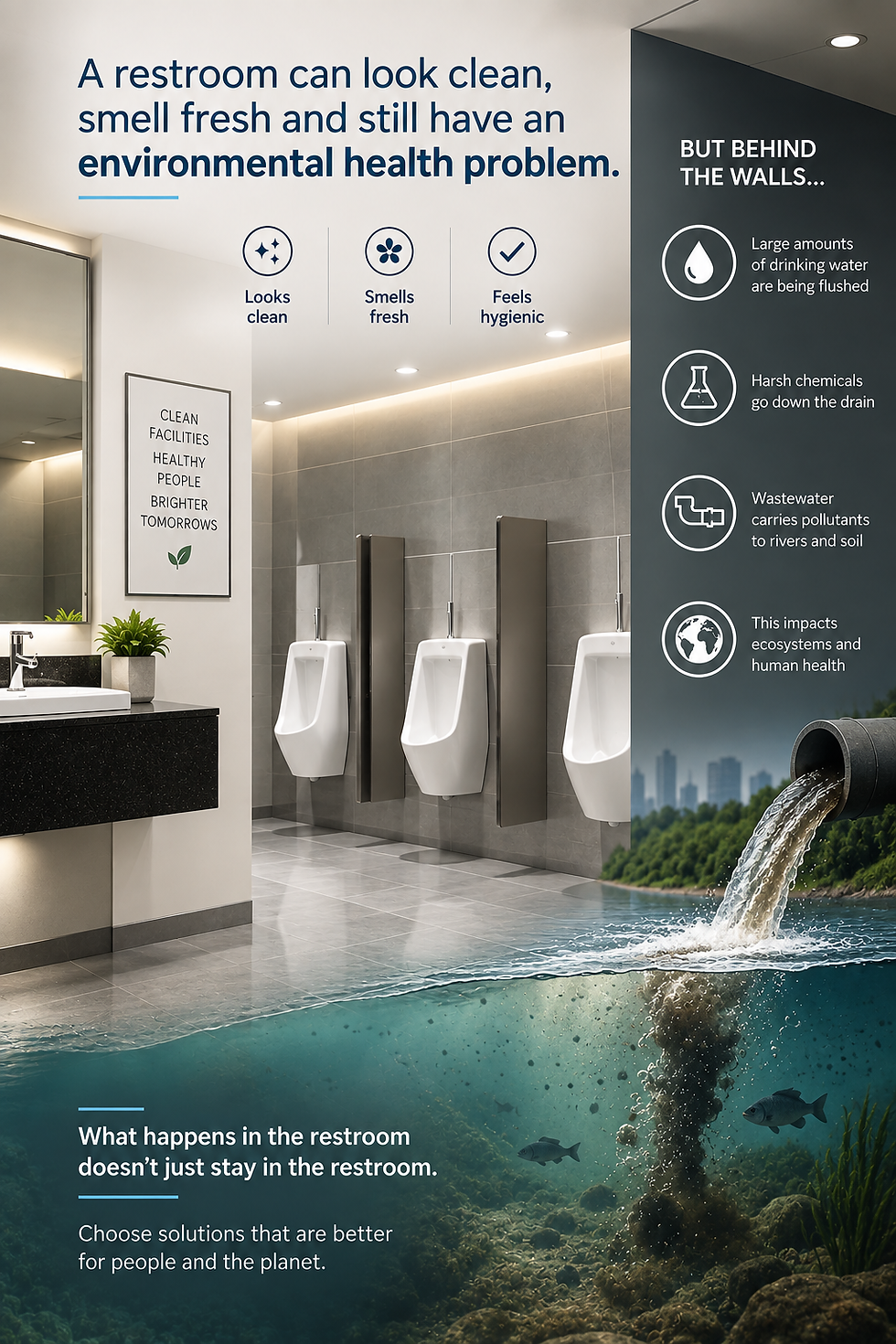
The Restroom is more than a cleaning problem
A busy restroom is a small built environment with constant human activity. Water moves through it. Urine and other organic material enter it. Cleaning chemicals are applied to surfaces. People touch doors, taps, dispensers and flush handles. Floors and other surfaces can become wet. Air moves through a relatively enclosed space. Each of these factors matters. Research on public restrooms has found diverse microbial communities across toilet, floor and frequently touched surfaces. Human-associated bacteria were common across the environments studied. A more recent study examining 32 restrooms in 10 shopping malls also found substantial bacterial contamination across restroom surfaces, including organisms such as Klebsiella pneumoniae and Pseudomonas aeruginosa. The researchers emphasised the importance of improved cleaning practices and designs that reduce cross-contamination. That does not mean every restroom is a health hazard.
It means restroom hygiene deserves to be treated as an environmental-health system, not just a housekeeping checklist. And three areas deserve particular attention.
1. What is happening in the air?
Walk into a poorly maintained men's restroom and one of the first things you may notice is the smell. That familiar sharp, irritating odour is often associated with urine decomposition and ammonia. Urine itself is not simply “ammonia.” The chemistry changes after urination as urea is broken down, and poor drainage, residues, inadequate cleaning and persistent wetness can contribute to odour problems. For facility teams, the important point is this:Masking the smell is not the same as managing its source. Adding another fragrance can make a restroom smell different without addressing what is producing the odour in the first place.
This is where waterless urinal systems can change the operating model. Zerodor uses a mechanical valve that allows urine to pass into the drainage system while helping prevent sewer gases from travelling back through the fixture. The system operates without flushing water, electricity or chemical cartridges. That means the facility is not relying on repeated flushing to move urine through the system. It is also not relying on fragrance to make the restroom appear fresher. Move the waste. Control the backflow. Keep the restroom maintained. For a facility manager, that is a more useful way to think about restroom odour. ” “What is creating the odour, and how do we stop managing the symptom?”

2. More chemicals do not automatically mean a healthier restroom
A clean restroom needs cleaning. There is no shortcut around that. But cleaning strategy matters.
Commercial and healthcare facilities may use detergents, disinfectants, bathroom cleaners, bleach-based products, acids, fragrances and other specialised formulations. The right product depends on the surface, contamination level and infection-control requirement. The CDC specifically recommends selecting appropriate products for the setting, following manufacturer instructions, avoiding unnecessary exposure, and managing cleaning products according to their safety data sheets. There is also evidence that cleaning staff can experience occupational exposure to cleaning chemicals.
In one NIOSH evaluation at a hospital, environmental-services workers using a product containing hydrogen peroxide, peracetic acid and acetic acid reported work-related symptoms including eye and nasal irritation, asthma-like symptoms and shortness of breath. The evaluation noted that cleaning-product exposure should be considered when managing worker health and cleaning protocols. That does not mean disinfectants are inherently bad. In hospitals, they can be essential for infection prevention. Use the right chemistry for the right job, at the right concentration, with the right procedure. More chemical does not automatically mean more hygiene.
The CDC also notes that cleaning and disinfection should be based on the level of infection risk, and that cleaning products should be selected with safety, effectiveness and environmental considerations in mind. This is where bio-enzymatic cleaning can have a role in appropriate applications. Ekam Eco Solutions' CARE range is built around bio-enzymatic cleaning rather than conventional harsh-chemical positioning. For facilities looking to reduce their dependence on aggressive formulations for routine cleaning, it can be evaluated as part of a broader cleaning programme. The important word is programme. A product alone does not create environmental health. The product, dilution, frequency, method, staff training and monitoring all matter.

3. A wet floor is not just an appearance problem
A wet restroom floor is usually treated as a housekeeping issue. Mop it. Dry it. Move on. But persistent moisture changes the environment. Public-washroom research has shown that warm, humid environments can support the survival of microorganisms, while contaminated surfaces can become potential points for indirect transfer. A study of 55 public washrooms found bacterial contamination associated with hand-drying facilities and emphasised the importance of regular cleaning and maintenance. Another study found that restroom surfaces hosted diverse microbial communities, with distinct communities associated with floors, toilet surfaces and frequently touched areas. That makes dryness part of good restroom management.
Not because a dry floor guarantees a sterile restroom. It doesn't. A better target is to reduce unnecessary moisture, standing water and repeated wetting while maintaining proper cleaning and hygiene procedures. That means fixing leaks. Managing splashing. Improving drainage. Using appropriate cleaning methods. Drying high-traffic areas quickly. And reducing unnecessary water use where the task does not require it.
The Three-part approach to a healthier washroom
A better restroom does not need one magical product. It needs a better system.
Step 1: Reduce the source of avoidable odour
For men's urinals, a waterless system such as Zerodor can eliminate flushing water and use a mechanical valve to help control sewer-gas backflow. That changes the sanitation system instead of simply adding fragrance to it.

Step 2: Rethink routine cleaning chemistry
Use cleaning products according to the actual requirement of the area. For routine cleaning where appropriate, bio-enzymatic formulations such as CARE can be considered as part of a lower-chemical cleaning strategy. For healthcare settings and high-risk areas, follow the facility's infection-prevention protocols and use the products and disinfectants required for that risk level. CDC guidance emphasises that disinfectants should be selected and used according to the setting and manufacturer's instructions.

Step 3: Make dry-surface maintenance part of the protocol
A restroom should not be considered “clean” simply because it has been mopped. The maintenance checklist should also consider:Leaks. Standing water. Drainage. Splash zones. High-touch surfaces. Ventilation. Cleaning frequency. Product dilution. Drying time. These details determine what users actually experience inside the restroom.
The Facility manager has a bigger role than it appears
Restroom management is often split between multiple teams. Facility management handles infrastructure. Housekeeping handles cleaning. Procurement buys products. EHS monitors workplace conditions. HR hears employee complaints. Sustainability teams track water and chemical use . When these functions operate separately, the restroom can become a collection of small problems. A better approach connects them. The facility manager can ask:
How much water are our urinals consuming?
What products are our cleaning teams using every day?
Are workers exposed to strong cleaning chemicals unnecessarily?
Where are floors repeatedly getting wet?
Are odours being treated at the source or masked?
Which surfaces are touched most frequently?
Are our cleaning protocols based on actual risk?
These questions turn restroom maintenance into something more meaningful than keeping appearances. They turn it into environmental health management.
Clean is not the same as healthy
This is the shift commercial buildings need to make. A restroom can look spotless and still have unnecessary chemical exposure. It can smell strongly of fragrance while the source of the odour remains. It can be cleaned regularly while high-touch surfaces become contaminated again.
It can use thousands of litres of water simply to move urine through a drain. None of these observations mean that a restroom is automatically unsafe. They mean that “clean” is only one partofthepicture. Environmental health looks at the whole environment. Air. Water. Surfaces. Chemicals. Microorganisms. People. And the systems connecting them.
This World Environmental Health Day, start with the restroom
The IFEH's 2026 theme calls for environmental health professionals to stand with science to protect communities. For commercial buildings, that principle can begin somewhere very ordinary. The washroom. Look at what enters it. Look at what leaves it. Look at what people breathe. Look at what workers use to clean it. Look at which surfaces stay wet. Then look at the systems behind those outcomes.
At Ekam Eco Solutions, we approach sanitation and cleaning as connected parts of a healthier, more resource-conscious facility.
Zerodor addresses waterless urinal sanitation and odour management through a mechanical valve system.
Zerodor CARE brings bio-enzymatic cleaning options into the conversation around everyday facility maintenance.

Together with good cleaning protocols, ventilation, drainage and dry-surface practices, these solutions can form part of a more thoughtful restroom-management strategy. The goal is not to make the restroom sterile. The goal is to make it better managed. Better for the people using it. Better for the teams maintaining it. And better for the environment around it. Is your washroom really as healthy as it looks?Ekam Eco Solutions can help you look beyond appearance with a washroom health assessment covering sanitation, odour, water use, cleaning practices, chemical free use, surface conditions and maintenance.
Book a washroom health assessment today.


Comments