

World Cleanup Day 2026: From Clean Plates to Clean Cities — Turning Food Waste into a Resource
This World Cleanup Day, start with the plate
On September 20, World Cleanup Day will bring attention to the connection between our everyday choices and the cities around us. This year, that connection begins with something incredibly ordinary a plate of food. What remains on that plate can become part of a landfill problem. Or, with the right system, it can become compost. That compost can return to the soil. And that soil can support new growth. That is the circular story hidden inside food waste. From clean plates to clean cities, the journey does not begin at the landfill. It begins with what we choose to do next.

A clean city starts long before the garbage truck arrives.
It starts in the kitchen. It starts with the food left on a plate, the vegetable peels from a kitchen, the leftovers from a cafeteria and the organic waste generated every day by homes, hotels, offices, campuses and institutions. This is the idea behind the 2026 World Cleanup Day theme, “From Clean Plates to Clean Cities.” The message is simple but powerful, what happens to food after it leaves our plates can have a direct connection with the kind of cities we build. Food waste does not have to become landfill waste. With segregation, responsible processing and composting, something that looks like waste can become a resource again.
The food on your plate can shape the city you live in
Food waste is often treated as the unavoidable end of a meal. But a meal does not end when the plate is cleared. For the waste-management system, that is where another journey begins. A large office cafeteria, hotel kitchen, university campus or residential community can generate hundreds of kilograms of organic waste every day. When that waste is mixed with plastic, packaging and other materials, recovering its value becomes much harder. It is then collected, transported and eventually disposed of somewhere else. The problem has simply moved. A better system starts much earliers egregate organic waste where it is generated and process it as close to the source as possible. That is where composting becomes important.

Food waste doesn't have to be garbage
Peels, leftovers, fruit and vegetable waste, garden waste and other biodegradable materials contain organic matter that can return to the natural cycle. Instead of sending that material straight to a landfill, it can be processed into compost. The difference may seem small:
Kitchen → Bin → Landfill
versus
Kitchen → Segregation → Composting → Soil
But at city scale, that difference becomes significant. Composting reduces the amount of organic waste that needs to be transported away while creating a useful material that can support landscaping, gardening and soil management. It turns a disposal problem into a resource-recovery opportunity.
Ekam Eco’s Approach: From Food Waste to Compost
At Ekam Eco Solutions, our approach to waste management is built around a simple principle Don't just move waste. Manage it. Our food-waste composting solutions help organizations process their organic waste closer to where it is generated. This can be particularly useful for large campuses, institutions, residential communities, hotels, corporate facilities and other locations that generate substantial quantities of food and organic waste every day. The process starts with source segregation. Once organic waste is separated from plastic, glass, sanitary waste and other contaminants, it can enter a controlled composting process. Depending on the waste generation and application, decentralized composting can help organizations manage significant quantities of organic waste within their own premises. In one campus application, the system is designed to handle approximately 1–1.5 tonnes of food and organic waste every day. That means the waste generated on the campus does not necessarily have to become someone else's disposal problem. It can be processed where it originates.

From 1 tonne of waste to a resource
Imagine a campus generating a tonne of food and organic waste every day. The traditional approach is - Collect it. Load it. Transport it. Dispose of it. Now imagine a different approach. The waste is segregated at source. Organic material is collected separately. It enters an on-site composting system. After processing, the resulting compost can be used for landscaping and other appropriate applications. The destination changes. More importantly, the mindset changes. The waste is no longer viewed only as something to get rid of. It becomes a material that can be recovered.

Composting in circular economy in a very practical form
The circular economy can sound like a complex concept. Food-waste composting makes it tangible. A simple loop looks like this:
Food → Food waste → Compost → Soil → New growth → Food
Instead of a one-way system where resources are extracted, consumed and discarded, materials are kept in circulation for as long as possible. That is the thinking behind sustainable waste management. And it is why composting is not merely about reducing garbage. It is about recovering value from what we already have.
The hidden cost of sending food waste away
There is another reason decentralized food-waste management matters transportation. Every kilogram of organic waste that leaves a site has to be collected and transported. For large institutions and campuses, that can mean regular waste-collection vehicles, fuel, manpower and logistical coordination. The farther the waste travels, the more complicated the system becomes.
On-site or decentralized processing can reduce the amount of organic material that needs to leave the premises. For facility managers, this creates an opportunity to look at waste management not simply as a housekeeping function, but as part of resource efficiency and operational planning.

Clean cities need more than cleanup drives
World Cleanup Day brings people together to clean streets, parks, neighbourhoods, beaches and public spaces. But cleanup is only one part of creating cleaner cities. If the same waste continues to be generated and poorly managed, tomorrow brings another cleanup. That is why prevention and processing matter. A cleaner city needs systems that address waste before it becomes visible on the street. Better segregation. Better collection. Better treatment. Better recovery. And better use of the resources that remain in the waste stream.
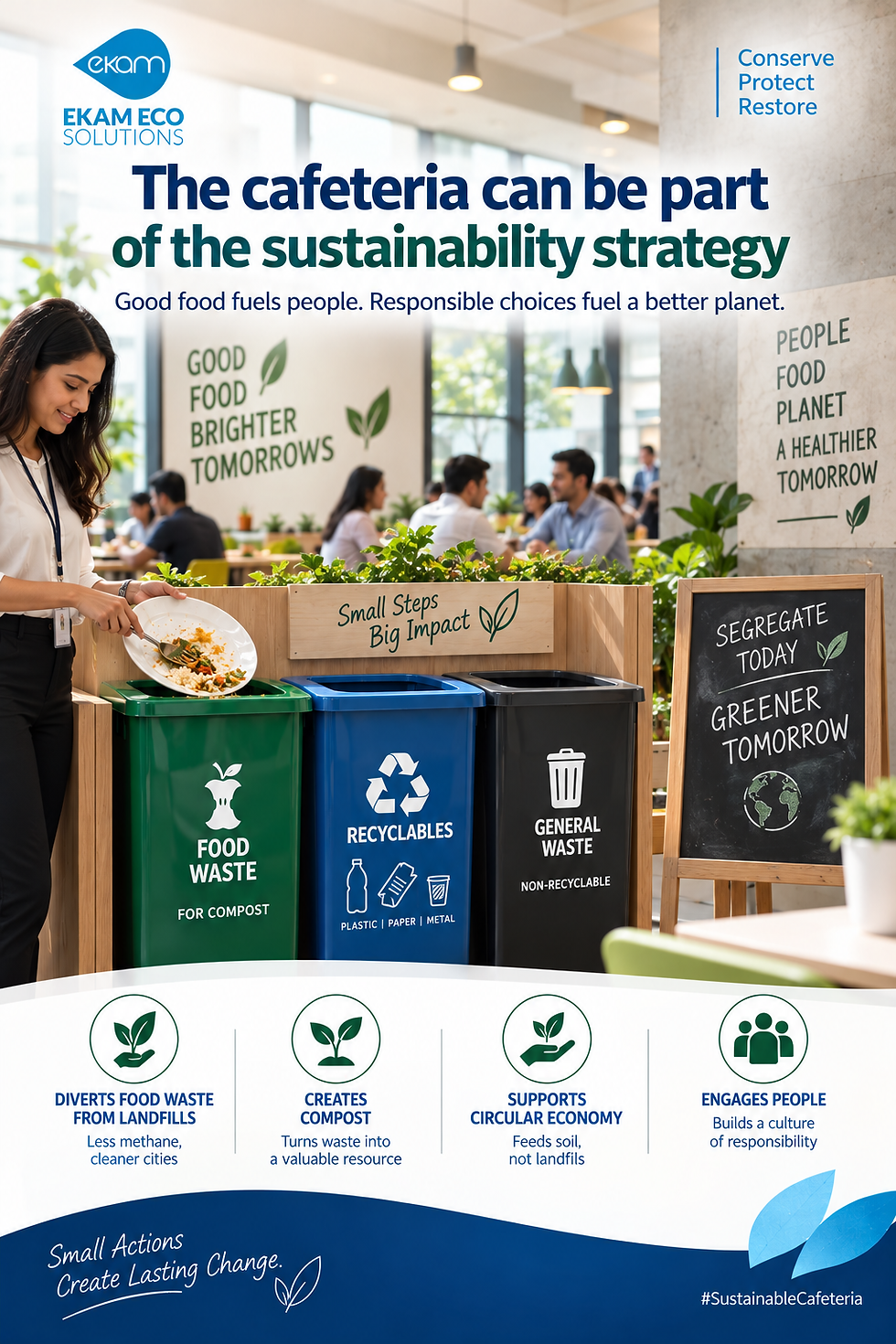
The cafeteria can be part of the sustainability strategy
For organizations, food waste management can become part of a much larger sustainability program. A corporate cafeteria can track how much organic waste it generates. A hotel can separate kitchen waste from packaging. A university can compost food waste generated across its campus. A residential community can process its organic waste and use the compost for its green spaces. These actions can also make sustainability more visible. Employees, students, residents and visitors can actually see where their waste goes. That visibility matters. Because sustainability becomes much easier to understand when it is not just written in an annual report but happening behind the building every day.
From clean plates to clean cities
The most interesting part of the World Cleanup Day theme is the connection it creates. A plate in a cafeteria may seem far removed from the cleanliness of a city. It isn't. The leftover food becomes waste. The waste enters a collection system. That collection system determines whether the material is recovered or discarded. And thousands of these small decisions eventually shape how our cities manage their resources. A clean city is not created only by cleaning better. It is created by designing better systems for what happens before, during and after waste reaches the bin.
What Ekam Eco believes
At Ekam Eco, we look at waste through the lens of resource recovery. Our work in food-waste composting is part of a broader approach to creating more responsible and circular waste-management systems. The goal is Less waste sent away. More resources recovered. More waste managed at source. Because the best waste-management system is not necessarily the one that moves waste faster. It is the one that makes less waste leave the site in the first place.
Build a better food-waste management system with Ekam Eco
If your organization generates significant quantities of food or organic waste, Ekam Eco can help you explore decentralized composting and resource-recovery solutions designed around your waste generation and site requirements. Don't just send your food waste away. Give it another life. Talk to Ekam Eco about your food-waste management requirements.
FAQs
Q1. What is World Cleanup Day 2026?
World Cleanup Day 2026 is being observed on September 20, bringing attention to responsible waste management and community action. The 2026 theme is “From Clean Plates to Clean Cities.”
Q2. What does “From Clean Plates to Clean Cities” mean?
The theme highlights the connection between food consumption, food waste and urban waste management. It encourages people and organizations to look at what happens to food waste after a meal and how better management can contribute to cleaner, more sustainable cities.
Q3. What is food waste composting?
Food waste composting is the controlled biological processing of organic waste such as food scraps, vegetable peels and other biodegradable materials into compost that can be used in appropriate soil and landscaping applications.
Q4. Why is source segregation important for composting?
Segregating organic waste at the point where it is generated helps keep plastic, glass, sanitary waste and other contaminants out of the composting stream. Cleaner input material makes organic-waste processing more effective.
Q5. Can large campuses compost food waste on-site?
Yes. Large campuses, institutions, hotels, residential communities and corporate facilities can use decentralized composting systems designed around their waste volumes, available space and operational requirements.
Q6. How does composting support the circular economy?
Composting keeps organic material within a biological cycle. Food waste can be processed into compost, which can then support soil and plant growth instead of being treated solely as waste for disposal.
Q7. What does Ekam Eco do in food-waste management?
Ekam Eco develops waste-management and composting solutions that help organizations manage organic waste closer to its source. Its approach focuses on segregation, decentralized processing and resource recovery.
Q8. How much food waste can an organization compost?
The appropriate system depends on the organization's daily waste generation, type of organic waste, available space and operational requirements. Ekam Eco has worked on applications involving approximately 1–1.5 tonnes of food and organic waste per day.
Q9. Who can benefit from food-waste composting?
Corporate campuses, educational institutions, hotels, residential communities, hospitals, commercial facilities, food businesses and other organizations generating significant quantities of organic waste can explore decentralized composting.
Q10. What can organizations do on World Cleanup Day?
Organizations can measure their food waste, improve source segregation, reduce avoidable food waste, donate safe surplus food where possible and explore composting or other appropriate organic-waste treatment options.


Comments