

National Engineers Day 2026: The Engineering Lesson Hidden Inside a Urinal
How one founder looked at something as ordinary as a urinal, and saw a billion-litre problem waiting to be solved.
National Engineers’ Day 2026: What Does an Engineer Really Build?
Every year on 15 September, India celebrates National Engineers’ Day in memory of Sir Mokshagundam Visvesvaraya, one of the country's most respected engineers and nation-builders. The day is more than a celebration of a profession it is a reminder of how deeply engineering is connected to India's progress. When we think of engineers, we often picture bridges, highways, dams, factories, machines, software and massive infrastructure projects. We imagine engineers building the physical foundations of a growing nation. And they certainly do. But India's biggest challenges today are not limited to what we need to build, they are also about what we need to save, reduce and rethink. Water is becoming harder to secure, cities are generating more waste, wastewater systems are under pressure and resources that once seemed unlimited are becoming increasingly valuable. This is where the role of an engineer begins to look different.

An engineer can help a country grow not only by building more, but by finding smarter ways to use what we already have. Saving a litre of water can be engineering. Reducing waste can be engineering. Designing a sanitation system that eliminates unnecessary water use can be engineering. In fact, the Government of India has repeatedly highlighted engineers as important contributors to innovation, problem-solving and nation-building. And that is where the story of Ekam Eco Solutions and Zerodor becomes particularly relevant because sometimes, engineering for India's future begins with something as ordinary as a urinal.
The Engineer Who Didn't Start Out Planning to Fix Washrooms
Uttam Banerjee, Co-founder and CEO of Ekam Eco Solutions, didn't set out with a plan to build a sanitation company. His journey started much earlier, growing up in a village in Jharkhand where there was no toilet or electricity at home. At the time, that was simply normal life. Years later, after studying engineering, completing his master's and working in the corporate world across Delhi, Mumbai and Hyderabad, his perspective began to change. A simple conversation with his wife before one of his visits to his village made him look at that childhood experience differently.
She asked him: “Is there a toilet there?” It was a simple question. But it stayed with him.
The things he had seen around sanitation, water and rivers began connecting in his mind. Eventually, the corporate career no longer felt like enough. He wanted to build something of his own. And that became Ekam Eco Solutions.
The Problem Was Sitting Inside Every Washroom
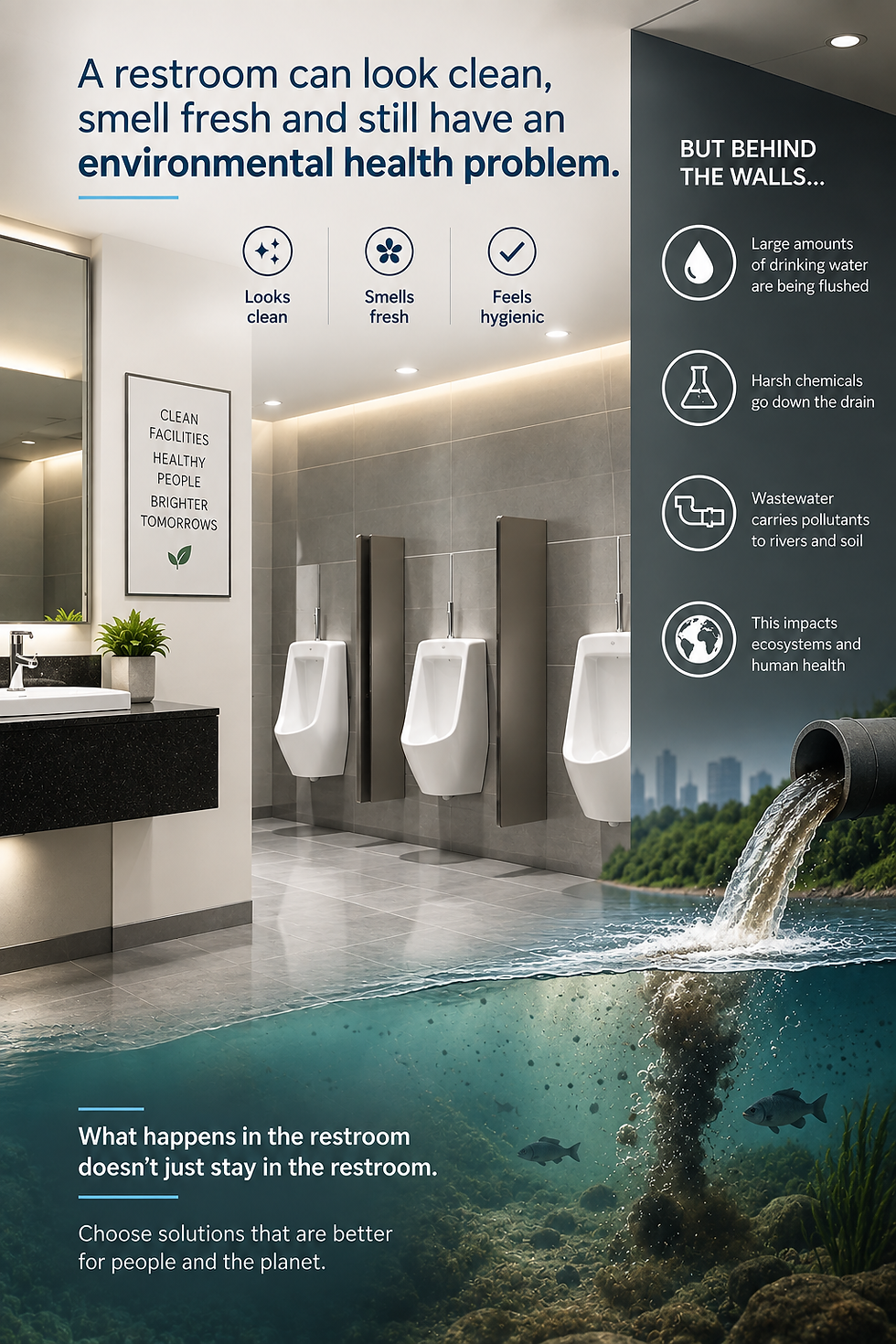
The sanitation problem is easy to overlook because it happens quietly. Someone enters a washroom. Uses a urinal. Presses a button. Water flows. And nobody thinks about it again. But in an airport, railway station, mall, factory, office or hotel, that same action happens hundreds or thousands of times. Every day. For years. The cumulative water consumption is enormous. Ekam Eco began looking at sanitation from three connected angles: reducing water wastage inside the washroom, reducing contamination in the wastewater that is generated, and recovering resources from that waste. Zerodor emerged from the first part of that thinking.
What if the flush wasn't necessary at all?

Waterless Urinals Had Already Failed in India
This is where the story gets interesting. Waterless urinals weren't a completely new idea. They had already been introduced in India decades earlier. And they hadn't exactly taken off. According to Banerjee, earlier systems struggled because they weren't designed around Indian usage behaviour and often came with recurring costs and maintenance challenges. That meant Ekam Eco wasn't entering an empty market. It was entering a market that already had a reason to be sceptical. So the challenge wasn't simply: “Can we build a waterless urinal?” It was: “Can we build one that actually works for India?” That distinction changed everything.

Engineering for the Real World
The team redesigned the approach around practicality. Zerodor uses a patented mechanical valve designed to allow urine to pass into the drainage system while helping prevent sewer gases and odour from returning through the drain. The system doesn't depend on conventional flushing.
It doesn't require oil sealants.
It doesn't rely on cartridge-based consumables.
It doesn't need electricity.
And it was designed with maintenance and operating costs in mind.
That last part matters. Because a sustainable technology that creates a new operational headache will struggle to become mainstream. The engineering had to work not just on paper, but in the hands of facility managers and housekeeping teams, inside busy Indian buildings.
And Then Came the Surprise
The team assumed water conservation would be the big draw. It wasn't. Odor control was. That realisation changed how Zerodor was positioned. Water saving remained a major environmental benefit, but the immediate value people experienced was a cleaner, odour-controlled washroom. This is an important lesson for engineers and innovators. Sometimes, the problem you think you're solving isn't the problem your customer actually wants solved. The technology may remain the same. But your understanding of its value changes. And that is not failure. That's engineering learning from reality.
The Best Engineering Doesn't Fight Human Behaviour
This is perhaps where Zerodor's story becomes bigger than a urinal. Technology doesn't exist in isolation.People interact with it. They develop habits around it. They maintain it,or don't. They accept it, or reject it. They recommend it,or complain about it. The most technically sophisticated solution can fail if it ignores those realities. Good engineering takes human behaviour seriously. That's why designing for India mattered. The objective wasn't to import an idea and expect people to adapt. It was to understand how people actually use washrooms and then engineer around those conditions. The product had to fit the people,not the other way around.
From One Urinal to Billions of Litres
Today, Zerodor has crossed 85,000+ installations, and Ekam Eco says the technology has helped save more than 3.5 billion litres of water. That is where the story comes full circle. A problem that started with something as ordinary as a urinal has grown into a measurable waterconservation impact. One flush doesn't look like much. But multiply it by thousands of users, thousands of buildings and thousands of days. Small engineering decisions become large environmental outcomes. That's the power of scale.

But Water Was Only the Beginning
Ekam Eco's work has expanded beyond waterless urinals. The company works across sustainable sanitation—from reducing water consumption to treating wastewater and recovering resources from it. The underlying philosophy remains similar: Don't treat waste as the end of the story.
Wastewater can be treated.
Resources can be recovered.
Water can be reused.
And systems can be designed so that sustainability becomes part of everyday operations rather than an expensive add-on. Banerjee has also spoken about one of the biggest barriers being not technological capability, but people's mindset around recycled water. The technology can treat wastewater to very high standards, but acceptance and appropriate end-use remain important considerations. That is another engineering lesson. Sometimes the hardest part isn't building the technology. It's getting people comfortable with the technology.
What Zerodor Teaches Us About Engineering
There is a tendency to imagine engineering as a straight line.
Problem.
Design.
Prototype.
Solution.
Real life rarely works that way. Real engineering looks morelike:Try. Listen. Fail. Understand. Redesign. Try again. Zerodor's journey reflects that. The initial assumption was that water saving would drive adoption. The market showed that odour control mattered more. Earlier waterless urinal designs had struggled in India. The team redesigned for local conditions. The result was not simply another waterless urinal. It was a solution built around the reality of how people actually use and maintain washrooms.

Engineering Isn't Always About Building More
For a long time, progress was measured by how much more we could build, produce and consume.
Sustainable engineering asks a slightly different question:
Can we achieve the same outcome using fewer resources?
Can a building function with less water?
Can wastewater become a resource?
Can waste be treated closer to where it is generated?
Can a system work without electricity or recurring consumables?
Can sustainability actually reduce operating costs rather than increase them?
These aren't just environmental questions. They are engineering questions. And they are becoming increasingly important as cities grow and resources become more constrained.
The Future Will Need Engineers Who Listen
World Engineering Day is a celebration of technology and innovation. But perhaps it should also be a celebration of something less glamorous:listening.
Listening to customers.
Listening to maintenance teams.
Listening to the environment.
Listening when a product doesn't work as expected.
And listening when the market tells you that the value you thought mattered isn't actually the value people care about. That kind of listening helped shape Zerodor. What started as an attempt to save water became a lesson in solving the problem people actually experienced. And that lesson continues to shape Ekam Eco's approach to sanitation. But by making them smarter, simpler and more resource-conscious. Zerodor is one small example. A mechanical valve inside a urinal doesn't sound like a world-changing invention. But when it is installed across tens of thousands of urinals and saves billions of litres of water, the scale tells a different story. And perhaps that's the real lesson behind World Engineering Day. Great engineering doesn't always look extraordinary. That is engineering worth celebrating. Happy World Engineering Day 2026.


A random post I read earlier included, so I took a moment to check it out. I only spent a short time navigating through it, mainly to understand how things were set up. The layout looks quite organized, and the design feels simple enough BJJ Kimono secure mobile streaming solutions to follow. It doesn't take long to get used to where everything is. Even without spending much time, leather motorcycle pants the overall experience feels quite smooth and manageable.
I found the point about engineering being more than just building new things particularly interesting. The Zerodor example shows how a simple everyday problem can lead to a practical solution when engineers pay attention to water usage, maintenance, and real user behaviour. The idea that saving resources can be as important as creating infrastructure is especially relevant as cities face growing environmental challenges.
The discussion also highlights how solutions often improve through testing and feedback rather than getting everything right the first time. Students dealing with academic pressure can relate to that process too. When coursework becomes overwhelming, some may even wonder whether to pay someone to do my online class, but learning how to manage responsibilities and seek appropriate…