

The Real Cost of Chemical Cleaning in Indian Offices: What Your Facility Budget Isn't Counting
For most offices, the cost of cleaning is easy to calculate. There is a monthly purchase order. There are invoices for toilet cleaners, floor cleaners, disinfectants, drain cleaners and other housekeeping chemicals. Procurement compares prices, negotiates rates and selects products that fit the budget. But there is a problem with looking at cleaning this way. The price printed on a cleaning bottle is not the complete cost of cleaning a building. A facility can spend less on cleaning chemicals and still spend more on maintenance, packaging, wastewater management and housekeeping operations. These hidden costs rarely appear under the "cleaning products" line item, but they are still part of the facility's operating expenditure. Most Indian offices know exactly how much they spend on cleaning products. The monthly purchase order might show ₹20,000 for toilet cleaner, ₹15,000 for floor cleaner, ₹8,000 for drain chemicals and so on. But that is only the visible cost. The bigger thing for facility managers is what happens after those chemicals are used?
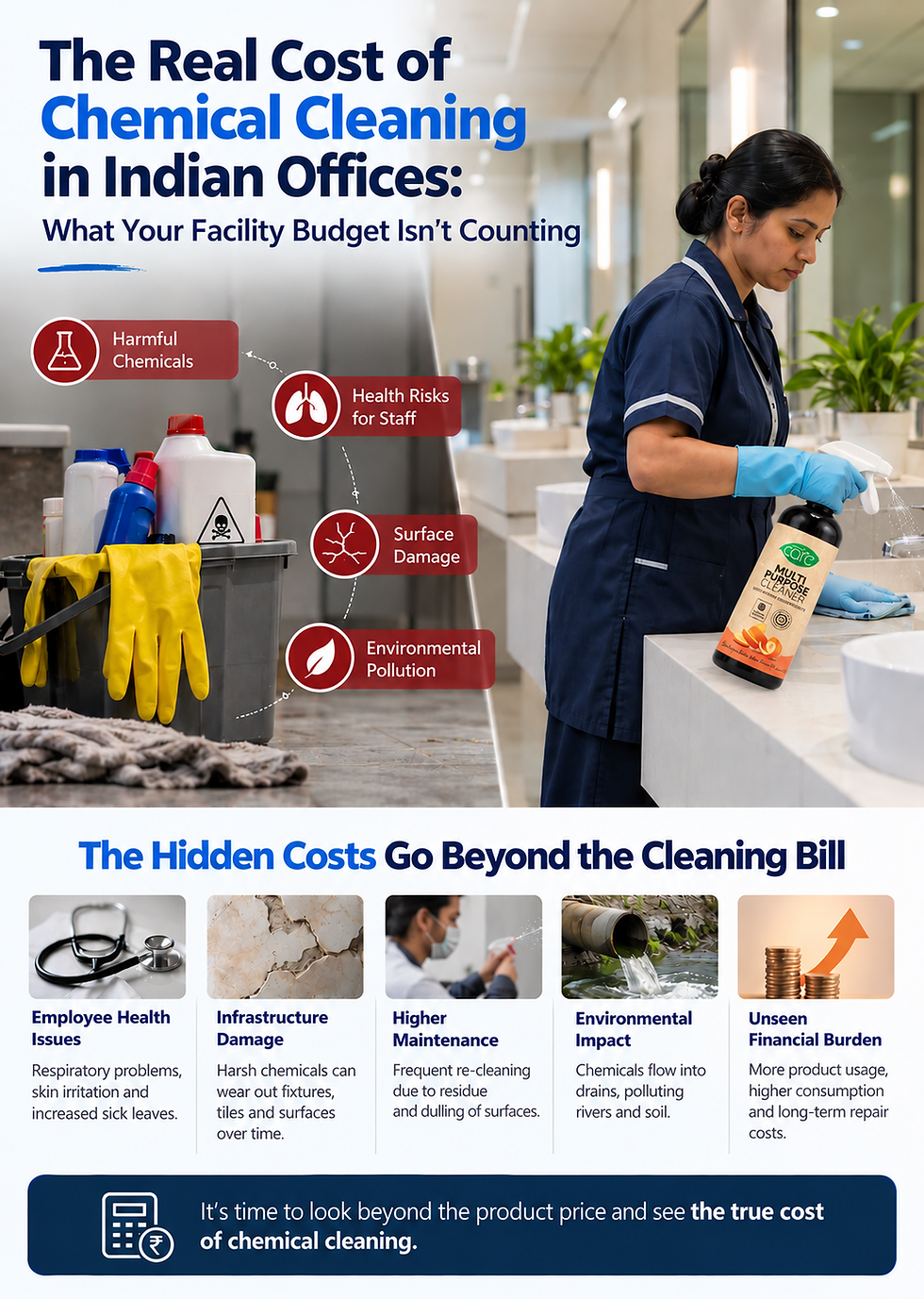
The Hidden Cost Behind a "Low-Cost" Cleaner
Consider a large commercial building where washrooms, kitchens, common areas and service areas are cleaned every day. When a strong chemical cleaner is used repeatedly, the immediate objective is achieved the surface looks clean. But facility teams also need to consider what happens with repeated chemical exposure to plumbing, surfaces and wastewater systems. Certain aggressive cleaning chemicals can contribute to corrosion or deterioration of susceptible materials when used improperly or excessively. The resulting cost may appear months later as plumbing repairs, replacement of components or additional maintenance. That repair bill may never be classified as a "cleaning expense. "But the cleaning practice may have contributed to it.
What Goes Down the Drain Matters
A commercial building is an interconnected system. Cleaning products used in toilets, kitchens and utility areas eventually enter the wastewater stream. In buildings with sewage treatment plants, this makes chemical selection particularly important. Wastewater treatment depends on biological processes. Excessive or inappropriate chemical inputs can interfere with biological treatment and may affect treatment performance, depending on the substance, concentration and system design. This means the housekeeping team and the wastewater-treatment team should not operate in completely separate silos. What housekeeping puts down the drain can become an STP concern. For facility managers, this is an important shift in thinking. A cleaning product should not be evaluated only by how quickly it removes dirt. Its wider impact on the building's water and wastewater systems also deserves consideration.

Then There Is Indoor Air
Offices are indoor environments where people spend a significant part of their day. Cleaning products can contribute to indoor air contaminants, including volatile organic compounds (VOCs), depending on their formulation. Strong fragrances can also create an impression of cleanliness without necessarily indicating that a surface has been cleaned better. For housekeeping teams, this creates another reason to examine product formulations. The goal should be straightforward effective cleaning without creating an unnecessary chemical burden inside the workplace. This is especially relevant when cleaning happens daily across hundreds of washrooms, desks, kitchens and common areas.

The Packaging Cost Nobody Puts in the Cleaning Budget
There is another recurring expense that is easy to overlook packaging. Imagine a facility purchasing ready-to-use cleaning products every month. Every purchase means more bottles, more transportation, more storage and eventually more packaging waste. Over a year, these small quantities can become significant. A refill-and-reuse model offers a different approach. Instead of treating every purchase as a completely new packaged product, facilities can reuse suitable dispensing containers and use larger refill formats where the product and application allow it. This can reduce packaging movement and simplify certain aspects of storage and procurement.

Where CARE Fits In
This is where Zerodor CARE takes a different approach to everyday cleaning. The range includes products for common facility requirements such as toilet cleaning, floor cleaning, dishwashing, multipurpose cleaning and drain maintenance. Its formulations are built around plant-based and bio-enzyme approaches, with options available in larger refill formats. For commercial facilities, the value is not simply that a product is marketed as "natural." The bigger opportunity is to look at cleaning as a complete operating system from purchasing and storage to daily housekeeping, wastewater and packaging.
Procurement Should Look Beyond ₹ Per Bottle
A better procurement comparison can start with five questions:
What does the product cost?
How frequently does it need to be purchased?
How much packaging is generated?
What maintenance or wastewater considerations come with its use?
Can the facility adopt a refill-and-reuse model?
This approach gives facility managers a more realistic picture of total cleaning expenditure. The objective is not necessarily to replace every product overnight. It is to identify where a different formulation, dosage, purchasing model or refill system can reduce unnecessary costs without compromising cleaning performance.

The Real ROI of Better Cleaning
Sustainability in facility management becomes more useful when it connects directly with operations. Using fewer unnecessary bottles can support waste reduction. Choosing appropriate formulations can support better chemical management. Refill formats can help streamline recurring procurement. Thoughtful chemical selection can reduce avoidable risks to building systems. And better product decisions can become part of a broader workplace-environment strategy. The cheapest cleaning product is not always the cheapest cleaning solution. A ₹200 bottle may look cheaper than a ₹300 alternative. But if one purchasing model generates more packaging, requires more frequent replacement, creates additional maintenance concerns or adds complexity to wastewater management, the comparison is incomplete. The real cost of cleaning is not what the facility pays when the bottle arrives. It is everything the building continues to pay after the bottle is empty. For offices looking to rethink their cleaning operations, explore the Zerodor CARE range and refill options at shop.ekameco.com.
FAQs: Chemical Cleaning Costs in Indian Offices
Q1. What are the hidden costs of chemical cleaning in offices?
The visible cost is the price of the cleaning product. Hidden costs can include packaging waste, storage, frequent repurchasing, maintenance of surfaces and plumbing, wastewater-treatment considerations, and potential indoor-air-quality concerns associated with certain formulations.
Q2. Are cheaper cleaning products always more cost-effective?
Not necessarily. Comparing only the price per bottle can give an incomplete picture. Facilities should also consider dilution, frequency of use, packaging, maintenance requirements, storage and overall consumption.
Q3. Can cleaning chemicals affect an office's STP?
They can, depending on the chemical, concentration and treatment system. Since sewage treatment plants rely on biological processes, facility teams should consider the compatibility of cleaning chemicals with their wastewater-treatment processes.
Q4. Why should facility managers care about VOCs in cleaning products?
Some cleaning products can release volatile organic compounds (VOCs) into indoor environments. Since offices are occupied for long periods, selecting cleaning products with an appropriate formulation can be part of a broader indoor-environment management strategy.
Q5. What is a refill-and-reuse cleaning model?
Instead of repeatedly purchasing new ready-to-use bottles, facilities can use larger refill formats and reuse suitable dispensing containers. This can reduce packaging consumption and simplify recurring purchasing and storage.
Q6. How can Zerodor CARE help commercial facilities?
Zerodor CARE offers cleaning products for applications such as toilets, floors, drains, kitchens and general surfaces. The range uses plant-based and bio-enzyme approaches and includes larger refill formats suitable for recurring consumption.
Q7. Is natural or bio-enzymatic cleaning suitable for offices?
It can be suitable for many routine office-cleaning applications. However, facilities should select products according to the surface, cleaning requirement, usage conditions and manufacturer's instructions.
Q8. How should CFOs calculate the real cost of office cleaning?
A broader calculation can include:
Product cost + consumption + packaging + storage + housekeeping requirements + maintenance + wastewater considerations = total cleaning cost.
This gives procurement teams a better basis for comparing different cleaning systems.
Q9. Can switching cleaning products reduce facility costs?
Potentially. Savings depend on product concentration, consumption, packaging, refill practices, procurement rates and the facility's existing cleaning system. A proper comparison should be based on total cost of ownership rather than bottle price alone.
Q10. What should procurement teams look for when choosing commercial cleaning products?
Procurement teams can evaluate cleaning effectiveness, formulation, dilution or dosage, frequency of use, packaging, refill availability, compatibility with building systems, housekeeping requirements and total cost of ownership not just the purchase price.
Q11. Why is chemical management becoming a facility-management issue?
Cleaning chemicals affect more than housekeeping. Product selection can have implications for indoor environments, wastewater, plumbing, storage, worker practices and recurring procurement. That makes chemical management relevant to the wider facility-management strategy.
Q12. Where can offices explore Zerodor CARE products?
Commercial teams can explore the Zerodor CARE range and available refill options through Zerodor CARE


Comments