

Rainwater Harvesting vs. Water-Efficient Fixtures: Which Should Your Building Invest in First?
When Every Rupee Counts, Where Should You Start?
Imagine you're responsible for managing a commercial building. Your water bills are rising. Sustainability goals are getting stricter. Occupants expect greener buildings. Management wants measurable savings, but there's one challenge. The budget is limited. You know your building needs to become more water efficient, but where should the investment go first? Should you install a rainwater harvesting system? Or should you replace conventional fixtures with water-efficient alternatives? The truth is, both are valuable. But if you're trying to achieve the biggest impact with the resources you have today, it's worth understanding what each solution actually delivers.
For many facility managers, builders, and business owners, improving a building's sustainability isn't a question of intent, it's a question of budget. With rising water tariffs, increasing maintenance costs, and growing pressure to meet ESG and green building goals, every investment needs to deliver measurable value. Whether you're managing a corporate office, hotel, hospital, manufacturing facility, or educational campus, deciding where to allocate a limited sustainability budget can be challenging. Should you invest in infrastructure that captures more water, or should you focus on reducing the amount of water your building consumes every day? The answer depends on your building's priorities, but one principle remains consistent- the fastest savings usually come from reducing demand before increasing supply.
Water-efficient fixtures can begin lowering water consumption from the day they are installed, while rainwater harvesting offers long-term resilience by supplementing water availability during the rainy season. Understanding the strengths of both approaches helps decision-makers invest wisely, maximise return on investment, and build a more sustainable facility without stretching their budgets. The smartest water strategy isn't about spending more, it's about spending where the impact is greatest.

Why Water Efficiency Has Become a Business Priority
Water is no longer just another utility expense. Across India, groundwater levels continue to decline in many regions, municipal water tariffs are increasing, and commercial buildings are under growing pressure to reduce their environmental footprint. Whether it's a corporate office, hospital, educational campus, hotel, manufacturing facility, or shopping mall, efficient water management has become essential for both operational resilience and sustainability. So how to do it in the smartest way possible.
Water is no longer just another operating expense, it has become a strategic business resource. Across India, declining groundwater levels, rising water tariffs, unpredictable rainfall, and increasing urban demand are making reliable water supplies more difficult and expensive to secure. At the same time, businesses are facing greater expectations from regulators, investors, customers, and employees to operate responsibly and reduce their environmental impact. For commercial buildings, manufacturing facilities, hotels, hospitals, educational institutions, and corporate campuses, using water efficiently is no longer just about conserving a natural resource, it's about managing costs, reducing risk, and ensuring uninterrupted operations.
Water efficiency also delivers measurable business value. Every litre of water saved reduces not only water bills but also the energy and costs associated with pumping, heating, treating, and disposing of wastewater. Efficient buildings require less maintenance, place lower demand on sewage treatment systems, and are better positioned to meet ESG commitments and green building certifications. Simple upgrades such as low-flow fixtures, rainwater harvesting, wastewater recycling, and Zerodor waterless urinals can significantly reduce freshwater consumption while improving long-term operational resilience. In a future where water scarcity is expected to become more common, businesses that invest in water efficiency today will be better prepared to stay competitive, compliant, and sustainable.

What Is Rainwater Harvesting?
Rainwater harvesting captures rainfall from rooftops or paved areas and stores it, or allows it to recharge groundwater, for future use. A well-designed system can provide water for landscaping, flushing, cooling towers, cleaning, and other non-potable applications. Benefits and Challenges of Rainwater Harvesting in Commercial Offices Rainwater harvesting is becoming an increasingly valuable solution for commercial offices looking to reduce their dependence on municipal water and improve sustainability. By collecting and storing rainwater from rooftops, office buildings can use this water for non-potable applications such as landscape irrigation, toilet flushing, cooling towers, and general cleaning. This reduces freshwater consumption, lowers water bills, and helps recharge groundwater when designed with recharge pits. For businesses pursuing ESG goals or green building certifications like LEED, IGBC, or GRIHA, rainwater harvesting also demonstrates a strong commitment to responsible water management and can enhance the building's environmental credentials. In cities where water scarcity and rising tariffs are becoming common, harvesting rainwater provides an additional source of water that strengthens long-term operational resilience.
However, rainwater harvesting is not a complete solution on its own. Its effectiveness depends largely on seasonal rainfall, roof catchment area, and adequate storage capacity. During prolonged dry periods or below-average monsoons, the amount of water collected may not be sufficient to meet a building's daily needs. Installation also requires upfront investment, dedicated space for storage tanks and filtration systems, and regular maintenance to ensure water quality and system efficiency. For this reason, many commercial offices achieve the best results by combining rainwater harvesting with water-efficient technologies such as low-flow fixtures, wastewater recycling, and Zerodor waterless urinals. While rainwater harvesting helps increase water supply, reducing daily water demand ensures that every litre collected is used more effectively, creating a smarter and more sustainable water management strategy.
Benefits
Reduces dependence on municipal water
Helps recharge groundwater
Supports regulatory compliance
Reduces stormwater runoff
Improves a building's sustainability profile
Challenges
Rainwater harvesting depends heavily on rainfall.
Storage tanks require space.
Initial installation costs can be significant.
During long dry seasons, the system may contribute very little to daily water demand.
In short, it provides water, but only when nature cooperates.

What Are Water-Efficient Fixtures?
Water-efficient fixtures are plumbing products designed to reduce water consumption without compromising performance or user comfort. These include low-flow faucets, dual-flush or low-flow toilets, sensor-based taps, efficient showerheads, and water-saving flush valves. By using advanced engineering such as aerators, pressure regulation, and optimized flow rates, these fixtures deliver the same functionality while using significantly less water than conventional alternatives. For commercial buildings, offices, hotels, hospitals, schools, and public facilities, they provide a practical way to reduce daily water usage with minimal changes to existing infrastructure. Water-efficient fixtures reduce water consumption every single day.
These include:
Low-flow faucets
Sensor taps
Dual-flush toilets
Low-flow showerheads
Aerators
Water-efficient flushing systems
Waterless urinals such as Zerodor
Unlike rainwater harvesting, these solutions don't depend on the weather. They immediately reduce the amount of water a building consumes.
Installing water-efficient fixtures is one of the quickest ways for organizations to lower water bills, reduce wastewater generation, and improve overall sustainability performance. Since less water is consumed with every use, buildings also benefit from lower energy costs associated with pumping, heating, and treating water. Many green building certifications such as LEED and IGBC encourage the use of water-efficient fixtures as part of broader water conservation strategies. While these fixtures don't eliminate water use entirely, they play an important role in helping businesses manage resources more responsibly and move closer to their environmental and ESG goals.

Why Water-Efficient Fixtures Often Deliver Faster Results
Think about how water is used inside your building. People wash their hands every day. They use restrooms every day. Cleaning happens every day. Every litre you don't consume is a litre you don't need to buy, pump, treat, or dispose of. That means water-efficient fixtures begin generating savings from the very first day they're installed. For buildings with high daily footfall, the return on investment can often be realised much sooner than large infrastructure projects.Water-efficient fixtures are often the fastest and most practical way for businesses to begin reducing water consumption because they can be installed with minimal disruption to daily operations. Replacing conventional faucets, dual-flush toilets, efficient showerheads, sensor taps, and water-saving flush valves immediately cuts water use without requiring major infrastructure changes.
In areas where suitable, switching to waterless urinals such as Zerodor can deliver even greater savings by eliminating flushing water altogether while maintaining hygiene and odor control. Together, these upgrades can start generating measurable water and cost savings from day one. The financial benefits are equally compelling. Lower water consumption translates into reduced utility bills, lower wastewater treatment costs, and decreased energy use for pumping and heating water. Since these fixtures require a relatively low upfront investment compared to large-scale water infrastructure projects, businesses often see a quicker return on investment. For organizations looking to improve their sustainability performance, meet ESG goals, or earn green building certifications, water-efficient fixtures, including innovative solutions like Zerodor waterless urinals, offer a high-impact, cost-effective first step toward long-term water conservation.
Rainwater Harvesting vs. Water-Efficient Fixtures
Factor | Rainwater Harvesting | Water-Efficient Fixtures |
Initial investment | High | Moderate |
Water savings | Seasonal | Daily |
Dependence on rainfall | Yes | No |
Maintenance | Moderate | Low |
Space requirement | High | Minimal |
Immediate impact | Limited | High |
ROI | Long-term | Faster |
Best for | Water supply | Water demand reduction |
So, Which Should You Invest In First?
If your goal is to reduce water consumption immediately, start with water-efficient fixtures.
Why?Because the cheapest litre of water is the one you never use. Reducing demand first makes every future investment more effective. Once your building consumes less water, rainwater harvesting systems can meet a larger share of that reduced demand, making the entire water management strategy more efficient.The answer depends on your building's current water challenges, budget, and long-term sustainability goals. If you're looking for quick, measurable savings with a lower upfront investment, water-efficient fixtures are often the best place to start. Upgrading to low-flow faucets, dual-flush toilets, sensor taps, efficient showerheads, and Zerodor waterless urinals can significantly reduce daily water consumption while lowering utility and maintenance costs. These improvements are relatively easy to implement and begin delivering results almost immediately.
However, if your facility experiences frequent water shortages, relies heavily on tanker water, or has sufficient rooftop and storage capacity, rainwater harvesting is a valuable long-term investment that helps build water resilience. The most effective strategy for many commercial buildings is not choosing one over the other but combining both approaches. Water-efficient fixtures reduce demand every single day, while rainwater harvesting increases your available water supply during the rainy season. Together, they create a comprehensive water management strategy that lowers operating costs, strengthens sustainability performance, and prepares your business for a future where every drop of water matters.
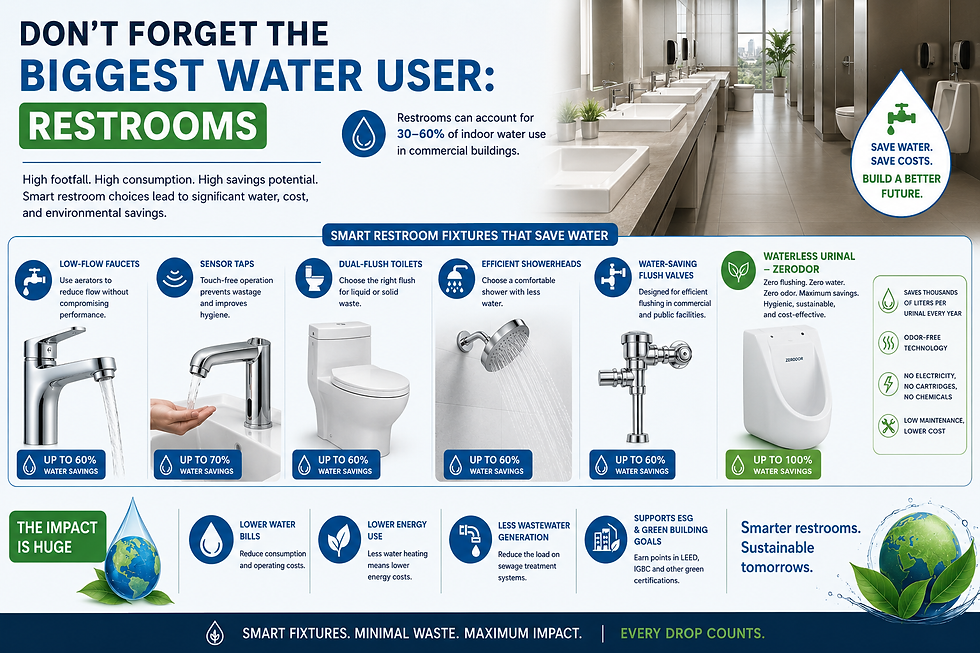
Don't Forget the Biggest Water User: Restrooms
In most commercial buildings, restrooms account for a significant share of daily water consumption.Yet they often receive the least attention.Traditional urinals continue using potable water with every flush, even in buildings already facing water shortages. While many organizations focus on reducing water use in cooling systems, landscaping, or manufacturing processes, one of the biggest opportunities for savings is often hiding in plain sight, the restroom. In commercial buildings, restrooms are among the highest consumers of potable water, with thousands of liters used every day for flushing, handwashing, and general sanitation. Even small improvements in restroom efficiency can lead to substantial annual water savings, especially in high-footfall locations such as offices, airports, malls, hospitals, educational institutions, and factories.
This is why modern restroom design is becoming a key part of corporate sustainability strategies. Installing water-efficient faucets, sensor taps, dual-flush toilets, and water-saving flush valves helps reduce unnecessary consumption. Taking it a step further, Zerodor waterless urinals eliminate the need for flushing altogether, saving thousands of liters of water per urinal every year while providing an odor-free, hygienic solution without cartridges, electricity, or chemicals. By rethinking restroom infrastructure, businesses can achieve meaningful reductions in water use, lower operating costs, and make measurable progress toward their ESG and sustainability goals. Switching to Zerodor Waterless Urinals can save up to 1.5 lakh litres of water per urinal every year, depending on usage. That means:
Lower water bills
Reduced wastewater generation
Less load on sewage treatment systems
Support for ESG and green building goals
Improved long-term operational efficiency
It's a relatively small infrastructure change that can deliver substantial savings over the lifetime of a building.
The Best Strategy Isn't Either-Or
This isn't a competition between rainwater harvesting and water-efficient fixtures. The most resilient buildings use both. First, reduce unnecessary water consumption through efficient fixtures. Then, supplement the remaining demand with harvested rainwater. This "Reduce First, Harvest Second" approach maximises savings, improves return on investment, and builds resilience against future water scarcity. The most effective approach to water conservation isn't choosing between rainwater harvesting and water-efficient fixtures ,it's combining both. Water-efficient fixtures reduce water demand every single day by minimizing unnecessary consumption, while rainwater harvesting increases the availability of an alternative water source during the rainy season. When these strategies work together, businesses can significantly reduce their dependence on municipal water supplies, lower operating costs, and build greater resilience against water shortages.
An integrated strategy becomes even more powerful when restroom water use is addressed. Along with low-flow faucets, sensor taps, and dual-flush toilets, Zerodor waterless urinals can eliminate flushing water entirely, delivering substantial long-term savings while maintaining hygiene and odor control. By pairing efficient fixtures with rainwater harvesting, organizations create a comprehensive water management system that supports ESG commitments, improves green building performance, and prepares facilities for a future where conserving every drop is both an environmental responsibility and a smart business decision.

Conclusion
Every commercial building is different.Budgets vary, water availability varies, operational needs vary. But one principle remains the same- Managing water demand should come before increasing water supply. Rainwater harvesting is an excellent long-term investment, especially in regions with reliable rainfall. However, if you're looking for the quickest, most measurable impact on water use and operating costs, water-efficient fixtures are often the smarter first step. For facility managers, builders, and business leaders, the goal shouldn't be choosing one solution over the other.It should be building a water strategy where every drop is used wisely.
Frequently Asked Questions
Q1. Which saves more water , rainwater harvesting or water-efficient fixtures?
Rainwater harvesting increases the availability of alternative water, while water-efficient fixtures reduce overall consumption. Fixtures usually deliver immediate and consistent savings because they reduce water use every day.
Q2. Is rainwater harvesting enough to solve a building's water needs?
No. Rainwater harvesting depends on rainfall, storage capacity, and seasonal conditions. It works best when combined with measures that reduce daily water consumption.
Q3. Why should commercial buildings prioritise water-efficient fixtures?
They lower water bills, reduce wastewater generation, require relatively low maintenance, and provide measurable savings from the day they are installed.
Q4. Are waterless urinals suitable for commercial buildings?
Yes. High-footfall locations such as offices, malls, airports, hospitals, factories, schools, and hotels can significantly reduce water consumption by installing waterless urinals while maintaining hygiene and reducing maintenance requirements.
Q5. What is the ideal water conservation strategy for commercial buildings?
The most effective approach is to reduce demand first using water-efficient fixtures and then supplement supply with rainwater harvesting, recycled water, and other sustainable water management practices.



Comments