

How a Portable Sewage Treatment Plant Works — And When Your Building Actually Needs One

Today, urban infrastructure is expanding at an unprecedented rate. The cities and the developing regions of India are seeing very rapid growth of Apartments, Commercial complexes, Hotels, Educational institutes, Hospitals, Industrial spaces etc. However, as the city grows, there is one big problem that is rarely thought of until it becomes a major issue: wastewater management. As construction moves faster, so do the volume of waterwastes and the lack of appropriate systems can have repercussions that are costly, unhealthy, and legally dangerous.
Wastewater is produced from every building, 24 hours a day, as a result of the operation of kitchens, washrooms, laundry areas, cafeterias and sanitation systems. When this wastewater is not properly treated, it can create environmental pollution, odours, groundwater contamination, drainage problems and significant legal compliance concerns that no property owner or facility manager wishes to consider. The problem is not contained — it spreads to neighbouring communities, water bodies and land.
That is why, the modern infrastructure is increasingly shifting towards smart wastewater solutions such as portable sewage treatment plants (Portable STP India) and decentralized sewage treatment systems. Companies and property owners are not merely seeking big, monolithic sewage systems today. They desire compact, efficient, easily installed, and cost-effective treatment solutions that can provide treatment in a limited space without impacting the existing infrastructure and operations.
Ekam Eco Solutions is about sustainable sanitation and smart environmental infrastructure. With more than a decade of field experience and a strong background of research from IIT Delhi, Ekam has established itself as a trusted brand among 700+ organizations in India. In addition to innovative sanitation solutions such as Zerodor waterless sanitation, Ekam's decentralised wastewater treatment solutions enable buildings to minimise their environmental footprint, make them more efficient and ensure compliance.
Why Is Sewage Treated?
Sewage is not just dirty water, but a combination of many harmful substances such as organic wastes, chemicals, oils and grease, harmful bacteria and pathogens, suspended solids, and nitrogen & phosphorus compounds. All of these contribute to a specific environmental hazard if they are not handled in a responsible way, and to a human health hazard in their own right.
The effects of untreated sewage discharge into the environment are serious and pervasive. It contaminates the rivers and ground water used by the communities for drinking and domestic consumption. Carries disease and harmful bacteria which infect individuals and animals in close proximity to contaminated water. It adversely affects aquatic environments by reducing oxygen levels and killing aquatic organisms. It produces potent unpleasant odours that render the area around it unpleasant and uninhabitable. It has implications for public health which take years to fix. Wastewater treatment is all about stopping this cycle from going around and around again — treating wastewater safely and responsibly before it goes into the environment or is reused.
What Is a Sewage Treatment Plant?

A Sewage Treatment Plant (STP) is a plant built specifically to treat the wastewater which is generated by residential, commercial, industrial and institutional buildings. The primary objective of an STP is to treat the wastewater to remove its contaminants, decrease its pollution levels, kill off any harmful bacteria and pathogens, enhance the quality of the water to acceptable limits and allow the treated wastewater to be disposed of or reused, as appropriate, in suitable applications. With the strain on urban drainage networks being enormous due to the speed of urbanisation, modern STP systems are designed to help deliver sustainable infrastructure while at the same time mitigating the environmental pressures.
Portable Sewage Treatment Plant Explained
Portable Sewage Treatment Plant: A small and mobile sewage treating system, which is developed and manufactured specifically for the sewage treating applications in places where it is difficult or impossible to build permanent large scale sewage treatment plants due to the limited scale of sewage generation. Portable STPs are modular, can be moved from site to site, installation is quicker and requires less disruption, can be installed in limited space like urban areas, and can be temporary or permanent decentralized installations.
In recent years, it has become common practice to use these systems in apartments which do not have a central drainage connection, in construction sites with a long construction period that generate wastewater during the project's construction, in hotels and resorts in peri-urban or remote areas, in commercial buildings with limited space, in industrial units with wastewater management needs, and at remote infrastructure projects where municipal wastewater systems are not available for connection.
What Is a Sewage Treatment Plant System?
A sewage treatment plant system is a sequential series of physical, biological and chemical processes engineered carefully together to achieve improved water quality at every step along the way until the treated water is finally discharged or reinjected. Wastewater usually enters the system through a series of collection chambers, through which oxygen is introduced to encourage biological activity in a series of aeration tanks, to separate solids from treated water in a series of clarifiers, to filter out fine particles and remaining contamination in a series of filters, and solid by-products of treatment in a series of sludge management units. The general function of this multiple stage process is to progressively remove contaminants from the water and enhance water quality to acceptable levels for the environment or for a re-use purpose.
How Does Sewage Get to the Treatment Plant?
The wastewater from washrooms, kitchens, drains, sinks and all other forms of sanitation in a building flow through a series of underground pipes into collection chambers at the input of the treatment plant. Then the sewage flows through the various treatment processes in a pre-programmed sequence before the treated water can be discharged into the environment or reused for reclaimed purposes within the building.
In decentralized sewage treatment systems (which pretty much summarizes how portable STP India systems work), wastewater is treated near the point of generation and not pumped long distances to a central point for treatment. This helps to decrease the infrastructure pressure on the municipal drainage system, substantially reduces transportation costs, decreases loss of water in transit, and mitigates overall environmental risk due to long-distance sewage transportation in the aging or overloaded pipe system.
The Working Principle of a Sewage Treatment Plant
The working principle of a sewage treatment plant follows a sequential process of removing solids from the liquid, oxidising the dissolved organic waste by biological activity, using various connected treatment stages to improve water quality over time, and eliminating harmful microorganisms which might pose a health risk. Modern portable STP systems integrate several biological, mechanical, and aeration stages to provide mechanical separation, biological treatment, oxygenation (aeration), fine particle filtration, and disinfection processes in an efficient and compact system design.
How Does a Sewage Treatment Plant Work?
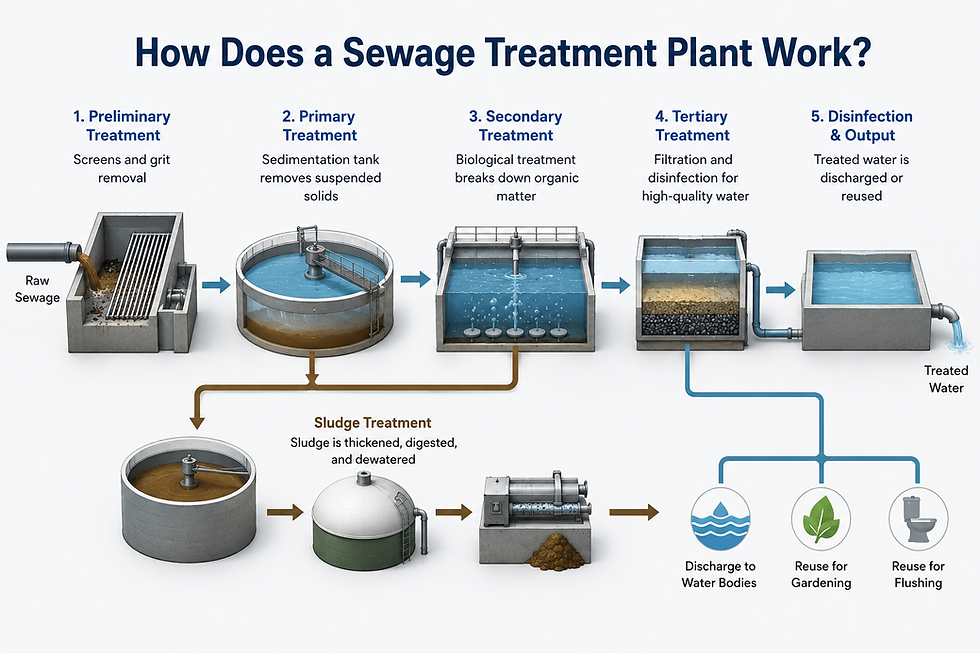
The wastewater treatment process occurs in several stages which are interconnected and carefully timed so that the treatment process is not lost.
Preliminary Treatment
Preliminary Treatment is the most basic process, in which big solids and debris are separated out of the raw sewage before it enters the Primary treatment process. This usually will take plastics, cloth, sand and grit, and large floating particles that might otherwise clog or damage downstream equipment. It is important to protect the system at the inlet to ensure long term operational efficiency.
Primary Treatment
Primary Treatment is the next step after which the wastewater is left to settle in tanks under controlled conditions. The heavier particles of solids settle at the bottom as sludge and lighter particles like oils and grease float at the top and can be skimmed off. This stage removes a substantial amount of suspended solids and will condition the wastewater for the subsequent more intense stage of biological treatment.
Secondary Treatment (Biological Process)
The biological phase of the treatment process is called Secondary Treatment and is perhaps the most significant in the overall treatment process. The dissolved organic matter that is left in the wastewater after primary treatment is biologically degraded by microorganisms, largely bacteria. This biological process decreases biological contamination, organic pollutants which cause oxygen depletion in water bodies, and odor causing substances which make untreated sewage so unpleasant. Specific biological technologies are used depending on the water treatment objectives, wastewater size and available space.
Tertiary Treatment
Tertiary Treatment is the most advanced purification step in which any remaining contaminants are removed by fine filtration and disinfection. This stage helps to substantially enhance water quality, and allow the resulting treated water to be used for irrigation and gardening, flushing systems inside the building, cooling systems in industrial buildings and for safe discharge into the natural environment, as per pollution control standards.
Sludge Treatment and Disposal
The solid waste produced during treatment is handled by Sludge Treatment and Disposal. The sludge from primary and secondary treatment needs to be stabilized (to stop further biological activity), dewatered (to reduce the sludge volume), and disposed of safely or treated further to produce useful products, such as fertilizer. Sludge management is not just a step-off_task; it is a vital part of the overall efficiency and adherence to regulations of the entire treatment system.
Common Types of STP Systems
Each building and application will have their own treatment technology and will require the selection of the most appropriate technology under consideration for a range of factors including wastewater size, space, treatment standards required and cost.
Activated Sludge Process (ASP) involves the use of aeration and active microorganisms for effective treatment of wastewater. One of the most popular biological treatment techniques in the world, it is effective for a variety of building types and sizes.
In a Sequential Batch Reactor (SBR) treatment is done in a series of controlled batches, a process which involves alternating between aeration and settling in the same tank. This method is very flexible and can be adapted to the variable wastewater flows which is a good solution for buildings with variable use patterns.
Membrane Bioreactor (MBR) is a combination of biological treatment and membrane filtration technology that will yield treated water of very high quality. MBRs are a good choice in situations where the treated water is reused in the building or where discharge requirements are more stringent.
Moving Bed Biofilm Reactor (MBBR) It is a technology based on specially designed floating carriers which have a large surface area for microbial growth in a compact reactor volume. In urban buildings that require treatment without compromising treatment efficiency, while space is limited, MBBR systems are particularly suitable.
Constructed Wetlands is a nature-based treatment method whereby plants, soil and naturally-occurring biological activity are used to treat wastewater in a low-energy, low-maintenance treatment system. These work best in larger properties that have land available and would prefer an ecological solution to treatment.
Key Features and Advantages of Portable STP India Systems

Compact Design
This is one of the most apparent benefits of portable STP India systems. Conventional large footprint treatment facilities are typically impractical in modern urban buildings, especially in dense urban areas. Portable systems are actually created specifically to offer complete treatment performance within a much reduced physical footprint, thus making it possible for properties that didn't have any sensible wastewater treatment choices previously.
Mobility
It provides portable sewage treatment plants the flexibility that a fixed system can't provide. They may be transferred when the construction project ends and the site changes, they can be transported to remote infrastructure installation sites where the construction of a permanent plant is not economical, they can be transported to sites of events that have a temporary wastewater flow, and they can be transported as commercial plants expand to new locations.
Simple Installation
Simple Installation in comparison to conventional systems, where a lot of civil work, excavation, and long construction periods are needed. Installing and commissioning portable STPs can be done in a matter of hours, directly minimizing construction delay, man hours down and initial investment in infrastructure.
Modularity
Modularity is the ability to add to portable treatment systems as the wastewater generation increases over time. This modular design preserves the initial investment as the plant treatment capacity can be increased as needed without making a large upfront payment for a capacity that may not be required for years.
Energy Efficiency
It presents a steadily increasing challenge, both with regard to the environment and to economics. Modern sewage treatment plants are engineered so as to reduce their power consumption and high treatment efficiency. These energy efficient systems lower operating costs, the building carbon footprint, and long-term maintenance costs — all of which can be directly impactful on the financial case for investing in adequate wastewater treatment.
Environmental Compliance
As wastewater regulations become more stringent in India, this is becoming more of a prerequisite. Pollution control boards are cracking down on discharges and buildings that do not meet their standards are subject to fines, shutdowns, and damage to their reputation. Mobile STPs are incorporated into the building certification and approval process to ensure adherence to pollution control norms, environmental discharge norms and the overall sustainable infrastructure requirement of the buildings.
Cost-Effective
The cost-effectiveness of decentralized sewage treatment systems is compared with the large centralized treatment systems, making decentralized sewage treatment systems truly accessible for medium-scale buildings. The lower installation costs, lower piping infrastructure requirements, lower transportation and civil construction costs, and reuse of treated water for non-potable applications onsite within the building make for a powerful return on investment.
Durability
Modern STP systems are accomplished by selecting materials and industrial grade components that are resistant to corrosion and are specifically designed for use in the chemically demanding wastewater treatment environment.
Treatment Efficiency
Treatment Efficiency in advanced portable sewage treatment plants is provided through design of better aeration system, optimized biological treatment protocols, advanced filtration stages, and increasingly automated monitoring system which senses and reacts to performance variations in real time. Treatment efficiency directly increases the opportunities for water re-use in the building and also minimises the environmental impact on the buildings wastewater.
When Does Your Building Actually Need a Portable STP?

Most property owners only think about a wastewater treatment system when the problem is quite serious and noticeable – which is often a much more costly, disruptive and more serious time to do so. If water usage is growing significantly due to poor water management, sewer backup or surface flooding due to drainage, risk of groundwater contamination from poor wastewater disposal, property has high wastewater volumes and it will be required to have connections expanded, Government regulations specifically require onsite wastewater treatment for the building category, water reuse for flushing or gardening is a goal, or when infrastructure expansions are planned that will significantly increase wastewater generation. Portable systems are particularly valuable in regions with weak or insufficient drainage systems, or where traditional solutions are not feasible.
The Role of Sewage Treatment Plants in Sustainable Urban Development
Sustainable Wastewater Management is crucial for urban development, as cities grow.
STPs support:
Water conservation
Pollution reduction
Resource reuse
Environmental protection
Sustainable infrastructure planning
This is in parallel with the sustainability-oriented initiatives of Ekam Eco Solutions and sanitation technologies such as Zerodor, which aim to minimize water usage and enhance hygiene conditions.
What Happens When We Ignore Wastewater?
Not addressing wastewater management does not solve the problem, it makes it worse. Over time, untreated sewage causes more and more pollution in the water, which only gets worse over time. It generates long-lasting unpleasant odors which impact on occupant comfort and property values. Provides conditions favourable for mosquitoes to breed and transmit vector borne diseases. It can directly affect the health of people in the building, employees and neighbours. It damages the natural environment and drainage systems physically. It also puts building owners and operators at risk of environmental penalties that are growing in importance with the growing intensity of regulatory enforcement in India. The impact of untreated sewage is not just on one building or building alone — it's on the surrounding ecosystem and on every individual who relies on it.
What to Consider When Choosing an STP
When choosing a wastewater treatment system:
Wastewater volume
Available space
Treatment technology
Maintenance requirements
Energy consumption
Future scalability
Environmental regulations
The right system can enhance long-term system efficiency.
About Ekam Eco Solutions & Zerodor
Sustainability is a focus at Ekam Eco Solutions. They make it happen with eco- infrastructure and smart toilet solutions. They also have strategies for managing wastewater. Their Zerodor system is a game-changer. It keeps toilets clean and odor-free without using water. This helps in a key areas:
Saving water
Building infrastructure
Creating toilet systems
Being responsible with the environment
Ekam Eco Solutions thinks about the earth when they create solutions like these. They want to make an impact on our planet.
Frequently Asked Questions (FAQs)
Q 1. How does a portable wastewater treatment plant differ from a fixed one?
Ans. Portable systems are small, mobile, modular, and simpler to install than permanent fixed plants.
Q 2. Can a portable water treatment plant treat industrial effluent?
Ans. Yes, many advanced portable systems are available to be designed for industrial wastewater treatment applications.
Q 3. What maintenance does a portable effluent treatment plant require?
Ans. Generally, biological systems need to be monitored and sludge removed, along with regular inspection and filter cleaning.
Q 4. Are portable sewage treatment plants environmentally safe?
Ans. Yes, modern portable STPs are designed to meet environmental discharge and pollution control standards.
Q 5. How long does it take to set up a portable sewage treatment plant?
Ans. The time of setting up varies from a few days to a few weeks, depending on the size and complexity of the project.
Q 6. Can treated sewage water be reused in apartments and commercial buildings?
Ans. Yes, treated sewage water can be reused for things. It is safe to use for flushing toilets, gardening, cooling systems and cleaning.
Q 7. Is a sewage treatment plant suitable for small residential societies?
Ans. Yes portable sewage treatment plants are good, for apartments and societies. They do not take up space. They also help treat wastewater right where it is needed.
Q 8. How water can a sewage treatment plant help save annually?
Ans. A good sewage treatment plant can help save a lot of water. It can help buildings reuse thousands of liters of water every day. This means we do not need to use much fresh water.
Conclusion
Today, treating wastewater is no longer a choice but a duty. With the increasing demand for water and the expansion of Indian cities, decentralized and portable sewage treatment systems are quickly becoming the effective and preferred choice of wastewater management for buildings of all sizes and types.
A properly designed portable STP India system can help enhance the hygiene levels at buildings, minimize environmental pollution, make effective use of treated water for non-potable purposes, comply with regulatory environmental requirements, and contribute to long-term sustainability objectives important to the building occupants, stakeholders, and communities. Proper wastewater treatment is more than a regulatory requirement for apartments, commercial buildings, hotels, educational institutions, and industrial spaces, it is a step towards building a cleaner, healthier, and more responsible future for all who live and work within its walls.
Comments