

From Lab to Scale: How India Can Turn Sustainable Innovation into Real-World Impact
Updated: 1 day ago
India has no shortage of ideas. Universities conduct research. Startups develop technologies. Engineers build prototypes. Companies test pilot projects. Government programs support innovation.
The real challenge begins after the idea is proven. A sustainable solution creates impact only when people, businesses and communities can adopt the sustainable solution at scale in every community and every workplace.
The sustainable solution requires more than performance. The sustainable solution requires affordability, reliability, easy installation, practical maintenance, infrastructure and measurable results.
The key theme in discussions around MFICSE 2026 was the journey from innovation to implementation. The focus moved beyond laboratories and prototypes to examine how sustainable technologies perform in operating environments. A technology may work perfectly under controlled conditions. Still struggling in the market.
Another solution may appear simpler. Succeed because the solution solves a clear problem that fits existing systems and delivers practical value. For India the next phase of development will depend on making innovation more usable, trusted, affordable and scalable today everywhere.
From invention to adoption
Changing from research to adoption is rarely easy. A researcher can prove a technology works. A customer looks at cost, reliability, maintenance and long‑term benefits.
Commercial adoption relies on practical factors:
Affordable installation and operation
Reliable performance in real conditions
Compatibility with existing infrastructure
Simple maintenance and servicing
Clear environmental and financial benefits
Acceptance by users and facility managers
Innovation depends on factors that decide if it stays a hopeful trial or turns into a real solution that makes a clear measurable difference, for business users and society.
Lab-to-scale innovation is not only about producing more units. It is about building a complete path from a real problem to research, testing, adoption, financing, implementation and measurement.
India’s Department of Science and Technology uses water‑technology programs that help research, field use, pilot tests, adoption, sale and copying of proven solutions.
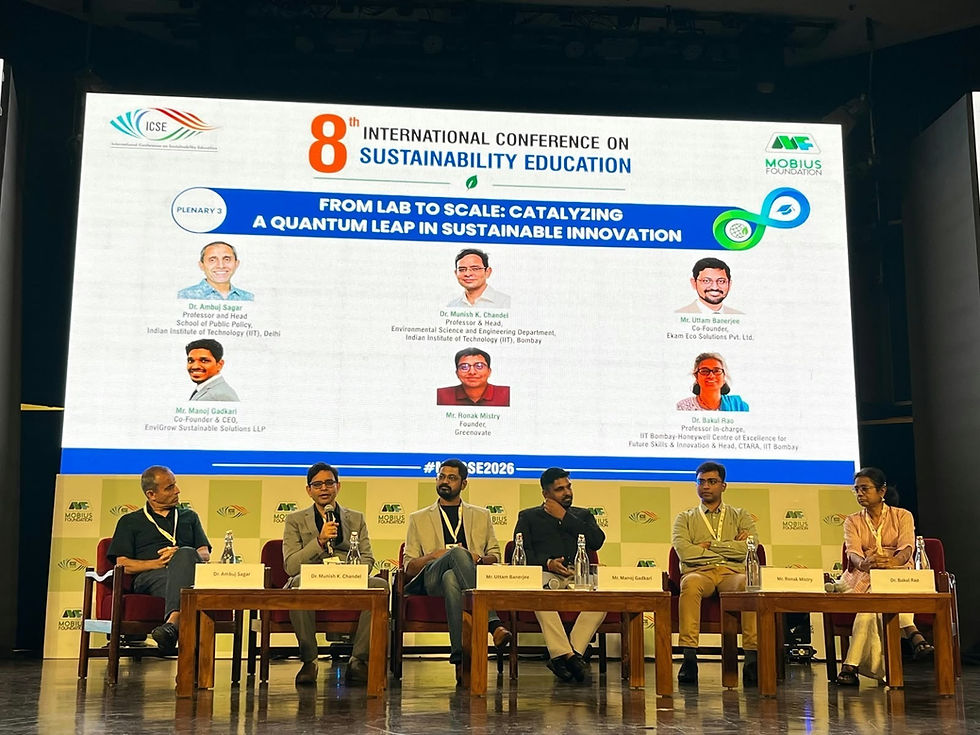
The lesson is clear: sustainable technologies must be made for the places where they will be used. 2026 Talks about "The Journey from Lab to Scale: Accelerating Sustainable Innovations" and puts this point into view. We must remember that sustainable technologies must fit needs and succeed. The session included Dr. Ambuj Sagar of IIT Delhi as moderator, Mr. Uttam Banerjee(Co-Founder & CEO) of Ekam Eco Solutions as a speaker, along with experts including Dr. Munish K. Chandel, Mr. Ronak Mistry, Dr. Bakul Rao and Mr. Manoj Gadkari.
Start with the problem, not the technology
Many innovations fail because they begin with a technology instead of a clearly defined problem.
A facility manager may not be looking for advanced water-conservation equipment. They may be trying to reduce rising water bills and maintenance costs.
A hospital may need better hygiene and wastewater management. A hotel may want to reduce resource consumption without affecting guest experience. A factory may need to save water without disrupting production. A municipality may require a waste-management solution that works within limited budgets and manpower.
Each situation needs a way to handle it. Good innovation starts with knowing the problem, the people and the place where things happen. Technology helps to get the job done.
Expert Perspective — Uttam Banerjee, CEO, Ekam Eco Solutions
Pee & poo” — We work in the sector of pee & poo. “Point of resource” — Look at waste as a resource rather than simply waste. “there is no water scarcity, it is a water management issue”, the way we look at water, treat it changes. We keep talking about water and water scarcity, but are we actually helping in any way?
It started in the lab. We were looking at pee/poo processes. We studied the urine bag and understood that ammonia is the main cause of hygiene/odor factors. If we can control ammonia, there is no need for flushing water just to deal with the problem.
Waterless was a big failure in India because of the use of chemicals and cartridges, which made the solution expensive and difficult to sustain. The thought was to create a mechanical device instead. The device had to be mechanical in nature, simple, practical and not dependent on chemicals/cartridges.
From there, the focus shifted more towards odor, and the team worked towards finding a solution. The bigger idea was not just to make a waterless urinal, but to understand the real problem first and then engineer the solution around it. “This approach is especially important in India, where climate, infrastructure, budgets, population density and maintenance practices can vary widely.”
Water conservation and practical implementation
Water conservation shows why we need useful sustainability ideas. Most talk is about building systems or finding more water. Cutting how much we use is just as key. Buildings use water, for toilets, cleaning, cooling, lawns and more. Toilets use a lot—because they’re made to use water. We need to change that. Simple fixes can save big.
A flushing urinal uses water every time it is operated. In high-footfall facilities, these individual flushes can create substantial annual consumption. Waterless sanitation removes flushing water from the process instead of simply reducing the amount used.
Ekam Eco Solutions’ Zerodor waterless urinal technology demonstrates how sustainability can be integrated into existing infrastructure. The system is designed to eliminate flushing water without requiring a complete restroom redesign.
Ekam Eco’s latest published water report states that Zerodor has crossed 85,000 installations across commercial buildings, factories, educational institutions, hospitals, hotels, transport facilities and other high-footfall locations. The report also states that one Zerodor urinal can save more than 150,000 litres of water annually, depending on usage patterns and the conventional fixture being replaced.
Sustainability is easier to use when it is added to systems that people already use. This idea goes beyond a product. It shows that small changes can lead to gains. Buildings do not always need rebuilding to become more efficient, with resources. Changing or upgrading one process can give real environmental benefits while causing less disturbance.
What large-scale deployment teaches innovators
Deployment data provides insights that laboratory testing cannot always reveal. After thousands of installations, companies learn how users behave, which maintenance issues occur, what facility managers value and which installation conditions create challenges. This creates a continuous improvement cycle:
Deploy → Observe → Learn → Improve → Deploy again
This cycle is essential for scaling sustainable technologies. Ekam Eco’s experience shows why sustainability companies must remain connected to real operating environments. Its work across water conservation and sanitation provides practical insight into how environmental technologies perform after installation. The field is not the final stage of innovation. It is where the next stage of innovation begins.
Sustainability must also make economic sense
Environmental benefits alone may not be enough to drive adoption. Commercial buildings must control operating costs. Factories cannot risk production delays. Schools need solutions that staff can manage. Public facilities often operate with limited budgets and high user volumes.
The strongest sustainability solutions connect three forms of value: Environmental value, value, economic value and social value. Water-saving technologies can cut freshwater demand, wastewater generation and treatment needs, for communities. Waste-recovery systems can turn discarded materials into inputs, reducing landfill waste.
Energy-efficiency solutions can lower resource consumption and operating costs, saving money. When sustainability joins operational efficiency organizations have reasons to adopt sustainability now.
Policy can move innovation from pilot to industry
Technology also requires an ecosystem. The research institutes can create ideas but turning them into products needs factories, money, roads, rules, markets and laws. India’s critical minerals recycling program is an example.
In 2025 the Union Cabinet approved a ₹1,500 crore incentive scheme for critical minerals recycling. The program helps recover minerals from e‑waste, lithium‑ion batteries and scrap. The Ministry of Mines then issued rules. Opened applications for the scheme.
By April 2026 the Ministry said 58 companies were approved to join. These companies pledged a recycling capacity of 850 kilotons a year and an investment of ₹5,000 crore. This program is important because India’s future need for minerals will grow with electric cars, gadgets, batteries and clean‑energy projects for growth. Recycling products in use can cut India’s need for new mining and create a supply of valuable materials.
Critical-mineral recycling requires a complete ecosystem
Recycling a battery or recovering material from e-waste is only one part of the process. A successful circular value chain also requires:
Collection systems
Safe transportation
Proper handling
Sorting and processing
Recovery technologies
Buyers for recovered materials
Regulation and traceability
Financially viable business models
A circular economy is therefore an ecosystem, not a single recycling facility. The same principle applies to water conservation, waste management and energy efficiency. Installing equipment or processing materials is not enough. The surrounding system must support reliable and long-term adoption.
From waste to resource
A linear economy follows the pattern: Take → Make → Use → Dispose
A circular economy keeps materials and resources in use for longer through repair, reuse, recycling, recovery and redesign. For India, this approach has strategic value. E-waste and spent batteries are not only environmental liabilities. They can also become secondary sources of valuable materials.
The government’s critical-mineral recycling scheme recognizes e-waste, spent lithium-ion batteries and other scrap as potential feedstocks for mineral recovery. The opportunity is to build systems in which today’s waste becomes tomorrow’s resource.
What India needs to scale sustainable innovation
1. Design for Indian conditions
Test technologies in the environments where they will be used, including high-footfall facilities, varied climates, limited infrastructure and different maintenance practices.
2. Involve users early
Feedback from customers, technicians, facility managers and communities can reveal practical challenges before commercialization.
3. Measure real outcomes
Track water saved, waste diverted, materials recovered, energy avoided and operating costs reduced instead of focusing only on installation numbers.
4. Use existing infrastructure
Retrofit-friendly solutions can reduce disruption, lower adoption costs and make implementation easier.
5. Strengthen research-industry partnerships
Researchers, businesses, users and government agencies bring different strengths that can help move ideas from laboratories to markets.
6. Include financing from the beginning
Scaling requires capital for manufacturing, testing, installation, servicing, marketing and customer support.
7. Build trust through evidence
Companies should clearly explain how their solutions work, where they have been deployed, what results have been measured and how those results were calculated.
Ekam Eco’s role in practical sustainability
Ekam Eco’s work reflects the importance of developing environmental solutions for real facilities.
Its waterless sanitation experience focuses on reducing a specific source of daily water consumption through a solution that can work with existing restroom infrastructure.
The company’s latest field report draws on more than 85,000 Zerodor installations to highlight the relationship between everyday sanitation choices and water conservation in India’s built environment.
This deployment experience shows why sustainability solutions must be evaluated beyond laboratory performance. Their success depends on whether they work after installation, whether users accept them, whether facility teams can maintain them, whether they deliver measurable savings and whether the model can be repeated. That is how innovation becomes an impact.
The lab-to-scale model
India’s sustainability journey can be represented as:
Real problem → Research → Prototype → Field testing → User feedback → Product improvement → Business model → Financing → Adoption → Measurement → Scale
Every stage matters. A strong invention without a customer remains an invention. A successful pilot without financing remains a pilot. A commercially attractive product without measurable environmental benefits may not create a meaningful sustainability impact.
When technology, economics, user needs, policy and measurable outcomes come together, innovation becomes part of everyday infrastructure.
Implementation is the future of sustainable innovation
India does not need to choose between innovation and implementation. It needs to connect them.
The discussions around MFICSE 2026 highlight the importance of moving sustainable technologies from laboratories into the places where people live, work, travel, study and conduct business. This requires:
Designing around real needs
Testing under real conditions
Listening to users
Measuring outcomes
Building viable business models
Creating supportive policies and partnerships

From waterless sanitation and decentralized waste management to e-waste recycling and critical-mineral recovery, India has significant opportunities to create practical environmental impact.
The success of an innovation will not be measured by how impressive its prototype looks. It will be measured by how much real-world change it creates.
The next sustainability breakthrough may not be the invention of another technology. It may be the ability to take existing technologies and make them work reliably, affordably and widely. That is the journey from innovation to implementation. That is how sustainable ideas become lasting environmental impact.
Frequently Asked Questions
What is lab-to-scale innovation?
Lab‑to‑scale innovation takes research‑based ideas. Brings them into everyday use. This happens by testing the idea, improving it, securing funding and putting it into practice. Lab‑to‑scale innovation guarantees that the technology performs well in life, not just in a lab.
Why is scaling sustainable technology difficult in India?
Scaling technology in India is hard because it depends on many factors. Cost, the availability of infrastructure, rules and regulations, ongoing maintenance and whether users accept the technology all matter. Scaling sustainable technology must be built for India’s operating conditions.
How can India accelerate sustainable innovation?
India can speed up innovation by bringing together researchers, startups, industries, governments and local communities. By providing funding testing solutions in the field and creating policies India can make adoption faster.
Why is water conservation important for sustainable development in India?
Water conservation matters for development in India because it cuts down on fresh water use and reduces the amount of wastewater produced. Water‑efficient fixtures, treatment and reusing water all help to use resources more wisely.
What role does the circular economy play in India's sustainability goals?
The circular economy helps India reach its sustainability goals by keeping materials in use. Recycling, reusing and recovering materials all help reduce waste, save resources and make domestic supply chains stronger.
Why is critical mineral recycling important for India?
Critical mineral recycling is vital for India because it pulls materials out of batteries, e‑waste and industrial scrap. This cuts down on imports and backs clean‑energy and technology sectors.
How does Ekam Eco contribute to sustainable innovation?
Ekam Eco brings solutions to water conservation, sanitation, waste management and sewage treatment. Its technologies help institutions, industries and public facilities practice sustainability.
What is the biggest lesson from moving sustainability innovation from lab to scale?
The biggest lesson, from moving sustainability innovation from lab to scale is that success requires practicality, affordability and scalability. Real environmental impact comes from putting ideas into action, not just inventing them.
Comments