

Facility Manager's Checklist: 7 Signs Your Washroom Needs a Waterless Urinal Upgrade
- bhumikat1
- 2 days ago
- 9 min read
"If your washroom keeps creating problems despite regular maintenance, the issue may not be your housekeeping team , it may be your urinals."
As a facility manager, you're often the first person people call when something goes wrong in the washroom. A foul smell, a leaking flush valve, an unusually high water bill, or repeated maintenance complaints , these issues may seem unrelated, but they often point to a common problem: an outdated restroom system. While housekeeping teams can clean more frequently and maintenance staff can perform repairs, recurring washroom problems usually indicate that the infrastructure itself is no longer operating efficiently. The result is a constant cycle of complaints, increased operating costs, and time spent solving the same issues over and over again.
That's why it's important to look beyond daily maintenance and evaluate whether your washroom setup is truly supporting your facility's operational goals. Waterless urinals are no longer just a sustainability feature , they're becoming a practical solution for reducing water consumption, minimizing maintenance requirements, lowering STP load, and improving restroom performance. This checklist is designed to help facility managers identify the warning signs that their current system may be costing more than it should. If several of these challenges sound familiar, it may be time to consider an upgrade that saves both water and operational effort.
Sign #1: Persistent Odor Despite Daily Cleaning
Few things generate more complaints than a washroom that smells unpleasant. What's frustrating for many facility managers is that these complaints often continue even when the housekeeping team is following a strict cleaning schedule. Floors are mopped, urinals are disinfected, air fresheners are replaced, and yet the odor keeps returning. In such situations, the problem is rarely a lack of cleaning effort. Instead, it may indicate deeper issues within the restroom infrastructure, such as scaling inside urinal pipes, ineffective flushing, trapped organic deposits, or drainage-related problems that routine cleaning simply cannot solve.
Over time, these recurring odor issues can impact occupant satisfaction and create the perception that the facility is poorly maintained, even when significant resources are being spent on housekeeping. Facility managers often find themselves treating the symptom rather than addressing the source of the problem. If your team is cleaning more frequently but receiving the same complaints, it may be time to ask a different question: Is the current urinal system contributing to the issue? Identifying the root cause can help reduce complaints, improve restroom conditions, and free your housekeeping staff from constantly fighting the same battle.
Checklist Question:
☐ Do restroom odor complaints continue despite regular cleaning schedules?

Sign #2: Your Water Bill Keeps Rising
A rising water bill is often blamed on increased occupancy, seasonal demand, or higher utility tariffs. While these factors certainly play a role, many facility managers overlook one of the biggest hidden consumers of water in a commercial building , the washroom. Traditional urinals use water with every flush, and in high-traffic environments such as offices, malls, hospitals, airports, and educational institutions, those flushes add up quickly. What appears to be a small amount of water per use can translate into thousands of liters consumed every day and lakhs of liters over the course of a year.
The challenge is that this consumption often goes unnoticed because it happens gradually. Unlike a visible leak, excessive flushing water doesn't trigger an immediate alarm, yet it quietly increases both water procurement costs and wastewater generation. If your building's water bills continue to rise despite stable occupancy levels and no major operational changes, it may be time to look closer at your restroom fixtures. Facility managers who identify and eliminate unnecessary water consumption often discover that some of the easiest savings opportunities are hiding in the most frequently used spaces of the building.
Checklist Question:
☐ Have your water costs increased even though building usage hasn't changed significantly?

Sign #3: Frequent Plumbing Complaints
Every facility manager expects occasional plumbing issues, but when urinal-related complaints become a regular part of the maintenance schedule, it's often a sign of a deeper problem. Leaking flush valves, malfunctioning sensors, clogged drains, overflowing urinals, and inconsistent flushing are more than just minor inconveniences , they consume valuable maintenance resources and disrupt daily operations. While each issue may seem manageable on its own, the cumulative impact can result in higher repair costs, increased downtime, and a constant stream of service requests that pull your team away from more strategic facility management tasks.
The hidden cost of recurring plumbing problems isn't just the money spent on repairs , it's the time and effort spent responding to them. Every maintenance call involves manpower, replacement parts, vendor coordination, and operational interruptions. Over months and years, these recurring issues can become a significant burden on both budgets and maintenance teams. If your staff regularly receives complaints related to urinal performance or plumbing failures, it may be worth evaluating whether the existing fixtures are creating unnecessary operational challenges. Sometimes, the most cost-effective solution isn't another repair , it's upgrading to a system designed with fewer moving parts and lower maintenance requirements.
Checklist Question:
☐ Does your maintenance team frequently deal with leaking flush valves, sensor failures, blockages, or urinal-related service calls?

Sign #4: Your STP Is Constantly Under Pressure
For many facility managers, sewage treatment plant (STP) challenges have become a daily operational concern. High energy consumption, excessive sludge generation, fluctuating treatment performance, odor complaints, and increasing maintenance requirements are all signs that the system is working harder than it should. While operators often focus on optimizing the treatment process itself, the real issue may begin much earlier , at the point where water is being unnecessarily consumed. Every liter used in washrooms eventually becomes wastewater that must pass through the STP, increasing the load on pumps, blowers, aeration systems, and treatment units.
When wastewater volumes continue to rise, so do operating costs. More water entering the STP means more electricity consumption, more sludge handling, more equipment wear, and more resources required to maintain compliance standards. Facility managers looking to improve STP efficiency often focus on treatment technologies, but reducing wastewater generation at the source can be equally effective. If your STP is constantly running at high capacity, requiring frequent intervention, or becoming a growing operational expense, it may be time to evaluate whether excessive flushing water is contributing to the problem. The less unnecessary water entering the system, the easier, and more cost-effective , it becomes to manage.
Checklist Question:
☐ Is your STP consuming more energy, generating more sludge, or requiring more maintenance than expected?

Sign #5: Sustainability Goals Are Becoming Harder to Achieve
Sustainability commitments are becoming increasingly important for commercial buildings, whether driven by ESG reporting requirements, green building certifications, corporate environmental targets, or stakeholder expectations. Organizations today are expected to demonstrate measurable improvements in resource efficiency, particularly when it comes to water conservation. However, achieving these goals becomes difficult when buildings continue to rely on systems that consume large volumes of potable water every day. Even with recycling initiatives and awareness campaigns in place, excessive water usage in washrooms can quietly undermine broader sustainability efforts.
For facility managers, this creates a growing challenge. Leadership teams want lower water consumption, better ESG performance, and stronger sustainability metrics, but those outcomes require practical operational changes. Water-intensive fixtures can make it difficult to show meaningful progress year after year. By identifying and eliminating unnecessary water use, buildings can significantly improve their conservation performance while reducing operational costs at the same time. If sustainability targets are becoming harder to meet despite ongoing efforts, it may be worth examining whether your washroom infrastructure is helping ,or hindering , your environmental objectives.
Checklist Question:
☐ Are water conservation targets, ESG goals, or sustainability benchmarks becoming increasingly difficult to achieve?

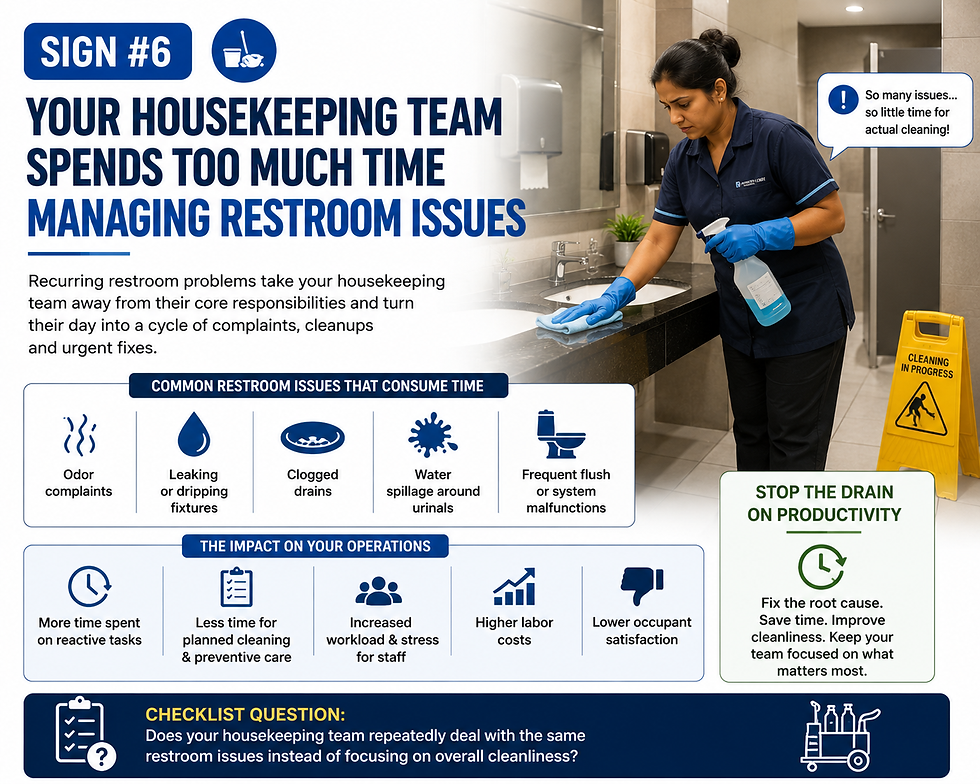
Sign #6: Your Housekeeping Team Spends Too Much Time Managing Restroom Issues
A well-managed housekeeping team should be focused on maintaining cleanliness, hygiene standards, and occupant comfort , not constantly responding to the same washroom complaints. Yet in many commercial buildings, a significant portion of housekeeping time is spent dealing with recurring issues such as unpleasant odors, water splashes around urinals, blocked drains, leaking flush systems, and repeated user complaints. These problems often require immediate attention, forcing staff to interrupt their routine tasks and revisit the same areas multiple times throughout the day.
Over time, this creates a cycle of reactive maintenance that affects both productivity and operational efficiency. Instead of focusing on preventive cleaning and overall facility upkeep, teams become occupied with troubleshooting recurring restroom problems. The result is increased labor effort, higher maintenance costs, and frustration for both staff and building occupants. If your housekeeping team is spending more time managing complaints than maintaining cleanliness, it may be a sign that the issue lies with the infrastructure rather than the people maintaining it. The best facilities don't require constant intervention , they are designed to minimize problems before they occur.
Checklist Question:
☐ Does your housekeeping team repeatedly deal with odor complaints, leaks, blockages, or restroom issues that keep returning despite regular cleaning?
Sign #7: Water Scarcity Is Becoming a Real Concern
Water scarcity is no longer a challenge limited to drought-prone regions or future projections , it's becoming a daily operational reality for many commercial buildings across India. Falling groundwater levels, increasing dependence on water tankers, unpredictable rainfall patterns, and rising urban demand are putting immense pressure on available water resources. As a result, facility managers are facing growing concerns around water availability, rising procurement costs, and the need to ensure uninterrupted operations even during periods of supply constraints. What was once considered a utility issue is now becoming a business continuity issue.
In this environment, every unnecessary liter of water consumption matters. Buildings that continue to use potable water inefficiently may find themselves paying more for a resource that is becoming increasingly scarce and expensive. Water conservation is no longer just about sustainability reporting , it's about protecting operational resilience and controlling long-term costs. If water shortages, tanker dependency, or rising water expenses are becoming regular discussion points within your organization, it's a clear sign that smarter water management strategies should become a priority. The facilities that adapt today will be far better prepared for the water challenges of tomorrow.
Checklist Question:
☐ Is your facility becoming more dependent on tankers, facing rising water costs, or experiencing concerns about future water availability?

The Facility Manager's Scorecard
How many boxes did you check?
0–2 SignsYour current system may still be meeting your needs, but monitoring water use and maintenance trends is recommended.
3–5 SignsYour washroom may be costing more than it appears. A water efficiency assessment could reveal significant savings opportunities.
6–7 SignsYour facility is likely experiencing multiple issues that a waterless urinal solution could help address. The cost of maintaining the current system may already exceed the cost of upgrading.
Why More Facility Managers Are Switching to Waterless Urinals Like Zerodor
Facility managers are constantly under pressure to reduce operating costs, handle maintenance issues, and meet sustainability targets all while keeping occupants satisfied. Zerodor Waterless Urinals help address these challenges by eliminating the need for flushing, saving thousands of litres of water every year. This not only lowers water bills but also reduces the volume of wastewater entering the sewage system, helping facilities operate more efficiently. With no flush valves, sensors, or water supply connections to maintain, facility teams can spend less time on repairs and more time on higher-priority tasks.
Beyond cost savings, Zerodor helps create cleaner and more sustainable buildings. By reducing water consumption to zero at the point of use, facility managers can contribute to ESG goals, green building initiatives, and water conservation commitments. The technology also helps control odours effectively, leading to fewer restroom complaints and a better user experience. For organizations looking to reduce resource consumption without compromising hygiene or performance, Zerodor offers a practical solution that delivers measurable operational and environmental benefits.

Conclusion
Facility managers are judged by what occupants notice.When a washroom smells bad, nobody blames the plumbing system.When water bills rise, nobody blames outdated fixtures.When maintenance requests pile up, nobody blames the flush valve.They call the facility manager. That's why the most effective upgrades aren't always the most visible ones. Sometimes, the smartest investment is simply removing a problem that shouldn't exist in the first place.
Because a great washroom isn't the one people talk about.
It's the one they never have a reason to complain about.
Frequant Asked Questions (FAQs)
1. What are the most common washroom complaints facility managers receive?
Persistent odors, high water consumption, leaking flush systems, blocked urinals, poor hygiene perception, and recurring plumbing issues.
2. How can waterless urinals reduce maintenance requirements?
They eliminate flush valves, sensors, and flushing mechanisms, reducing the number of components that require repair or replacement.
3. Do waterless urinals help reduce restroom odors?
Yes. Modern waterless urinals are designed with odor-control systems that prevent sewer gases from escaping when maintained correctly.
4. How much water can a commercial building save with waterless urinals?
Savings depend on usage levels, but high-footfall facilities can save lakhs of liters of water annually.
5. Are waterless urinals suitable for malls, offices, and hospitals?
Yes. They are widely used in commercial buildings, airports, educational institutions, industrial facilities, and healthcare environments.
6. Can waterless urinals help lower STP operating costs?
Yes. Reduced flushing water means lower wastewater volumes, which can decrease STP load, energy consumption, and sludge generation.
7. How do waterless urinals support sustainability initiatives?
They reduce freshwater consumption, support ESG goals, contribute to green building standards, and help organizations achieve water conservation targets.
8. What is the biggest advantage of switching to waterless urinals?
For most facility managers, it's not just water savings , it's eliminating recurring washroom problems that consume time, money, and resources.


Comments